
Do you know?
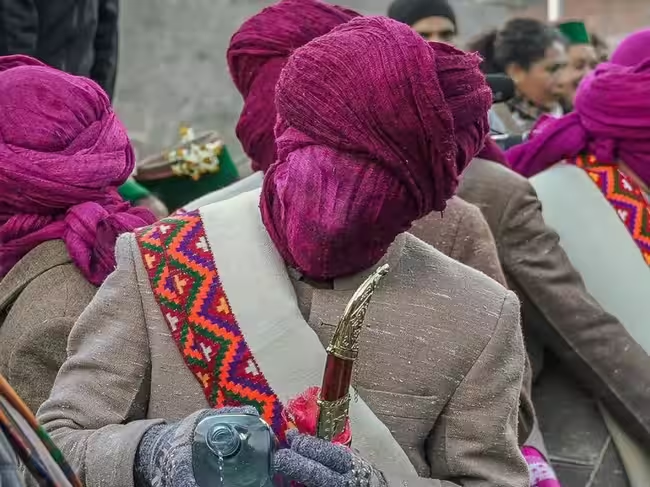
- Do you remember the viral picture from the Kinnaur and customs associated with it?
- ‘Jhauda’ or ‘Kwun’ custom of Lahaul Spiti is child protection Law?
- Kinnauras practiced three distinct methods for disposing of a dead body?
Introduction
“Do you remember the viral picture of a person from the Kinnaur district of HP? Here, the groom with a fully covered face is performing the customs of his community. Himachal Pradesh is home to many communities, and they have their own culture, customs, and traditions that form their unique identity. These customs make the region truly special.”
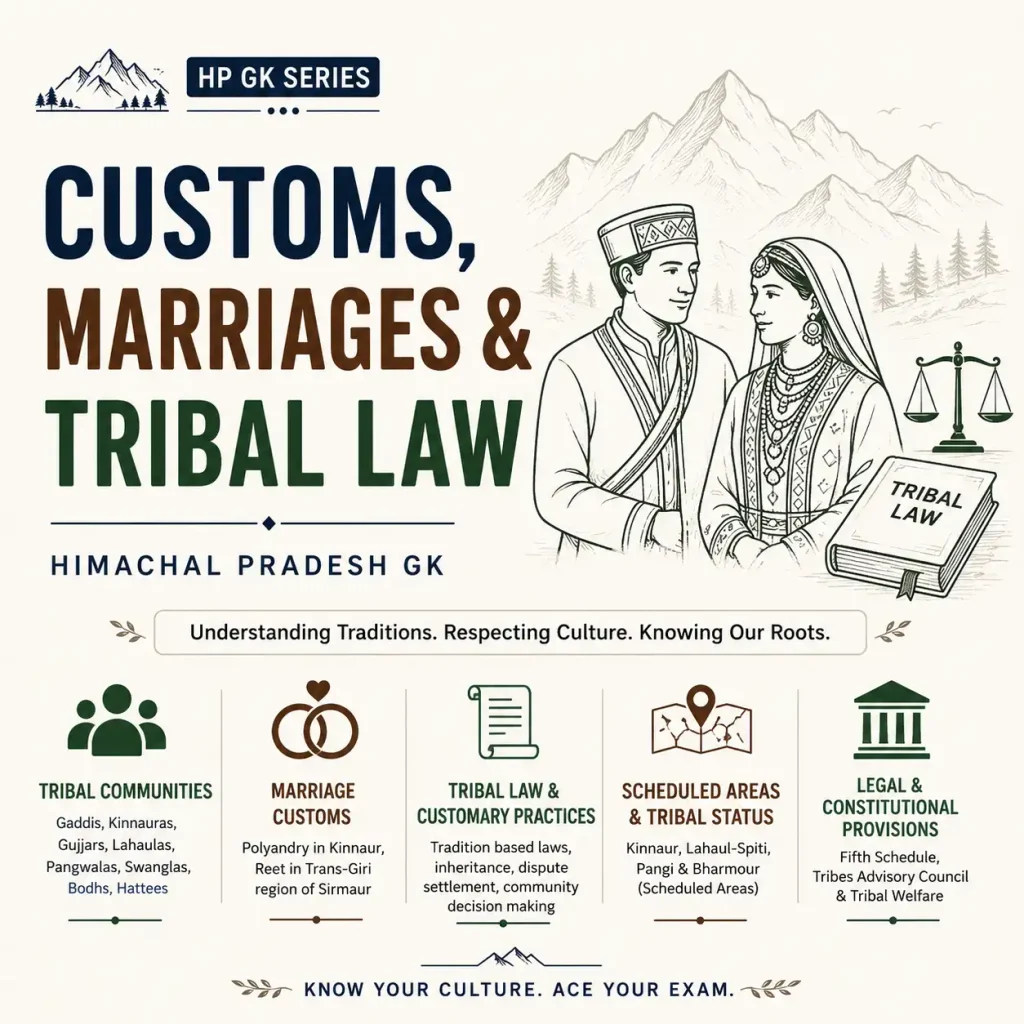
The Customs, Marriages & Tribal Law of Himachal Pradesh is an important topic in HP GK, History, Culture, Society, and Anthropology. It helps aspirants understand the traditional social practices, tribal communities, and customary laws that have shaped the cultural identity of Himachal Pradesh. Questions from this topic are frequently asked in HPPSC, HPAS, HP Police, HP Patwari, HPRCA, JOA, TGT, and other Himachal Pradesh Government exams.
Himachal Pradesh is home to several tribal communities such as the Gaddis, Kinnauras, Lahaulas, Gujjars, Pangwalas, Swanglas, and Hattees, each with its own customs, marriage traditions, inheritance practices, festivals, and local governance systems. Important concepts like Polyandry (historically associated with some Kinnaura communities), Reet marriage in the Trans-Giri region of Sirmaur, and the customary traditions of Gaddi and Kinnaura society are among the most commonly asked exam topics.
This practice set covers the major tribal communities, traditional marriage systems, customary laws, Scheduled Areas, and important socio-cultural facts of Himachal Pradesh in an exam-oriented format with answers, explanations, and quick revision facts.
Importance for HP Government Exams
This topic is particularly useful for HPAS and other HPPSC examinations, but selected factual questions are also relevant for Patwari, HP Police, JOA, HPRCA, Forest Guard, TGT and other HP Government exams.
For Patwari / JOA / Police / Other Objective Exams
Focus on direct factual connections:
- Kinnaura → Kinnaur
- Gaddi → Chamba & Kangra
- Reet → Trans-Giri/Sirmaur
- Polyandry → historically associated with Kinnaura communities
- Hatti → Trans-Giri, Sirmaur
- Pangi & Bharmour → tribal areas of Chamba
- Kinnaur & Lahaul-Spiti → Scheduled Areas
For HPAS / Higher-Level Exams
Go beyond memorisation and understand:
- Why traditional marriage systems developed in high-altitude societies
- Relationship between landholding, inheritance and family structure
- How customary law interacted with colonial administration
- Social reform and the historical debate surrounding Reet
- The transition from customary practices to statutory law
- Constitutional protection and administration of Scheduled Areas
- Fifth Schedule and the role of the Tribes Advisory Council
- Contemporary changes in tribal society due to education, mobility and economic transformation
Himachal Pradesh has had a Tribes Advisory Council since 13 December 1977, constituted under Article 244(1) read with the Fifth Schedule. The Council advises on matters concerning tribal welfare and development.
High-Value Facts for Revision
| Topic | Exam Point |
|---|---|
| Polyandry | Historically reported among some Kinnaura communities |
| Fraternal Polyandry | One woman married to multiple brothers |
| Traditional purpose often cited | Keeping family land/property undivided |
| Reet / Rit | Historical customary remarriage practice |
| Reet region | Particularly associated with Trans-Giri, Sirmaur |
| Gaddi | Major ST community of Himachal Pradesh; strongly associated with Chamba-Kangra |
| Kinnaura/Kanaura | Major ST community of Kinnaur |
| Hatti | ST status for the Trans-Giri area of Sirmaur |
| Scheduled Areas | Kinnaur, Lahaul-Spiti, Pangi & Bharmour |
| Tribes Advisory Council | Constituted in HP in 1977 |
| Constitutional basis | Article 244(1) + Fifth Schedule |
| Current marriage law | Statutory law applies; historical custom alone does not automatically establish legal validity |
Exam Tip:
Don’t prepare this topic simply as “strange customs of Himachal.” For higher-level exams, understand the social, economic, geographical and legal context behind each custom. A useful revision formula is:
Community → Region → Custom → Purpose → Historical Context → Present Legal Position
Test Your Knowledge
Are you ready to test your preparation? Dive into the 15 highly anticipated multiple-choice questions below and see how many you can get right!
Key Facts Recap
HP Places, Temples & Historical Inscriptions | HP GK
Geographical Rivers & Glaciers of Himachal Pradesh -HP Daily GK MCQs
📲 Get Daily HP GK Updates
Join our WhatsApp channel for daily HP GK MCQs, HPRCA job alerts & exam updates
Join WhatsApp ChannelRelated Pages: