
From the rhythmic, synchronized steps of the Kullu Nati to the mystical mask dances (Chham) performed in remote Trans-Himalayan monasteries, the state’s traditions are deeply tied to its geography. The martial echo of the Thoda archery dance, the historic winter bonfires of the Halda festival, and the unique tribal marriage customs of Kinnaur all tell a story of communities that have preserved their identity across centuries. Understanding this heritage is like unlocking the very soul of the Western Himalayas
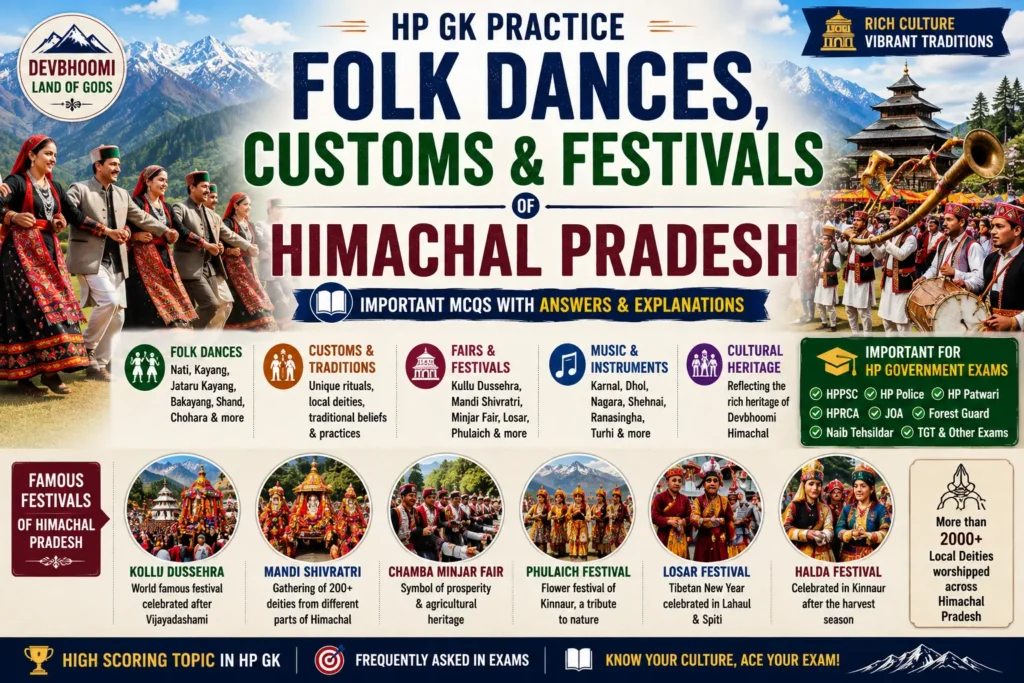
The folk dances, customs, and festivals of Himachal Pradesh represent the cultural identity of the state and form one of the most important topics in Himachal Pradesh General Knowledge (HP GK). Popularly known as “Dev Bhoomi” (Land of the Gods), Himachal Pradesh has a unique cultural heritage where every valley preserves its own traditions, local deities, rituals, dance forms, fairs, and festivals. These customs have been passed down through generations and continue to play a vital role in the social and religious life of the people. The state’s cultural landscape is shaped by more than 2,000 village deities (Devtas and Devis), whose traditions influence local governance, festivals, and community life.
Himachal Pradesh is famous for its vibrant folk dances such as Nati (recognized by Guinness World Records for one of the world’s largest folk dance performances), Kayang, Jataru Kayang, Bakayang, Shand, Chohara Dance, Jhoori, Rasa, and Rakshasa Dance. These dances are performed during festivals, weddings, harvest celebrations, and religious ceremonies, accompanied by traditional musical instruments like the Karnal, Ranasingha, Dhol, Nagara, Shehnai, Turhi, Manjira, Chimta, and Flute.
The state’s fairs and festivals reflect its deep-rooted spiritual traditions and agricultural lifestyle. Celebrations such as Kullu Dussehra, Mandi Shivratri, Chamba Minjar Fair, Renuka Fair, Phulaich Festival, Losar, Halda, Sazo, Fulaich, Shivratri, Lohri, and Winter Carnivals attract thousands of devotees and tourists every year. Many of these festivals are closely associated with local deities, seasonal changes, harvest cycles, and Buddhist traditions of Lahaul-Spiti and Kinnaur.
Exam Importance
The Folk Dances, Customs, and Festivals of Himachal Pradesh constitute one of the highest-scoring sections of HP Culture & Heritage, and questions from this topic are regularly asked in HPPSC, HP Police, HP Patwari, HPRCA, JOA, Naib Tehsildar, Forest Guard, TGT, and other Himachal Pradesh Government recruitment examinations.
Examiners frequently frame questions on:
- ⭐ UNESCO, Guinness World Record, and internationally recognized cultural events
- 🎭 Famous folk dances and the districts where they are performed
- 🛕 Major fairs and festivals with their associated deities
- 📍 Places where important festivals are celebrated
- 🌾 Harvest and seasonal festivals
- 🥁 Traditional musical instruments
- 🏔️ Tribal customs of Kinnaur, Lahaul-Spiti, Chamba, and Kullu
- 🧣 Traditional attire and cultural practices
- 🎉 Religious, Buddhist, and local deity festivals
One of the most important facts for examinations is that Kullu Dussehra is celebrated after Vijayadashami, unlike the rest of India where Dussehra concludes on Vijayadashami. Similarly, Mandi Shivratri is famous for the gathering of more than 200 local deities, while Minjar Fair symbolizes prosperity and the agricultural heritage of Chamba. The Nati dance has gained international recognition through a Guinness World Record performance involving thousands of participants
This topic is highly scoring because most questions are direct, factual, and repeatedly asked. Candidates are expected to know:
- the district associated with a dance or festival,
- the occasion on which it is celebrated,
- the deity or community connected with it,
- and its historical or cultural significance.
Mastering these facts also strengthens preparation for other HP GK topics such as Art & Culture, Temples, Tribes, Handicrafts, Traditional Attire, and Tourism.
Exam Tip:
While studying this topic, remember every festival or dance using this simple pattern:
Name → District → Occasion → Community/Deity → Unique Feature
This method covers the majority of questions asked in HP Government examinations.
Test Your Knowledge
Are you ready to test your preparation? Dive into the 15 highly anticipated multiple-choice questions below and see how many you can get right!
Key Facts Recap
📲 Get Daily HP GK Updates
Join our WhatsApp channel for daily HP GK MCQs, HPRCA job alerts & exam updates
Join WhatsApp ChannelRelated Pages:
➡️ Rivers of Himachal Pradesh – Complete Guide