
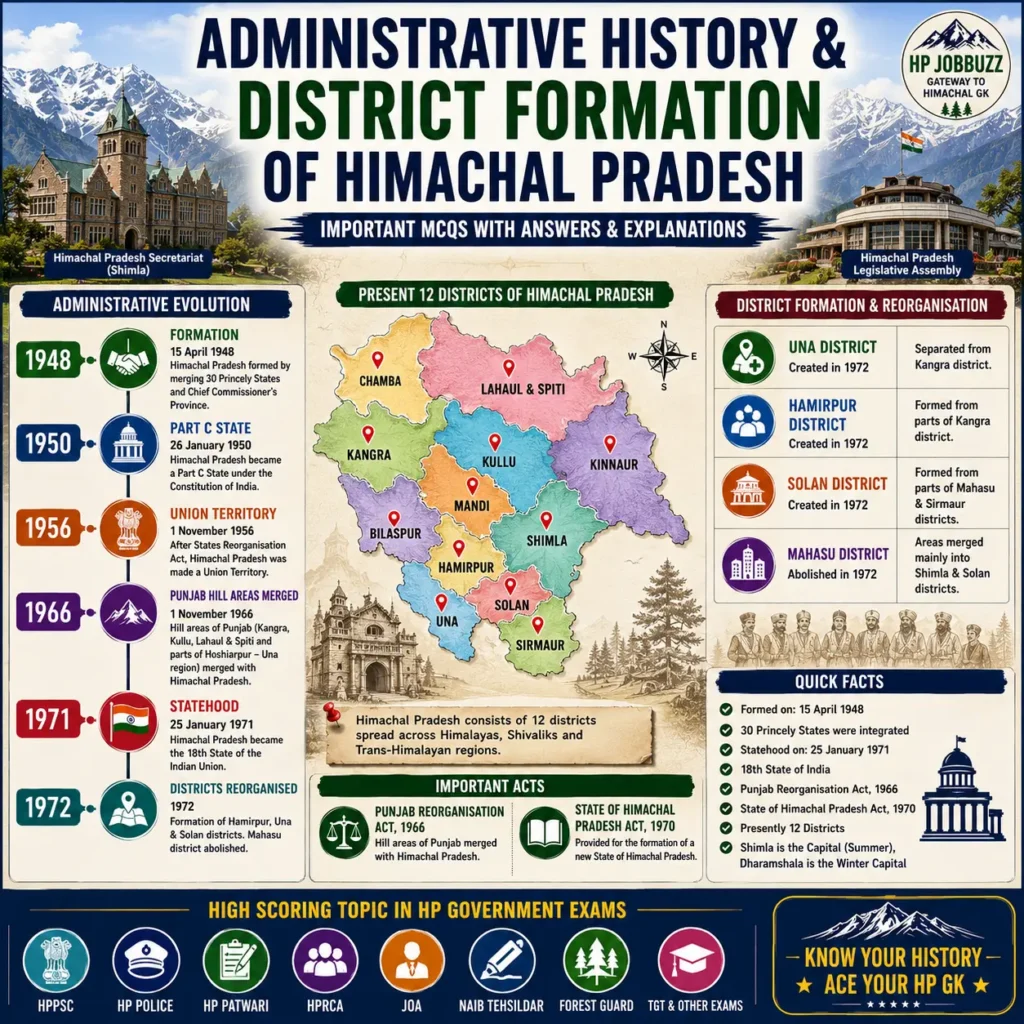
Before 1948, the region that now forms Himachal Pradesh consisted of 30 princely states and the Chief Commissioner’s Province of Himachal Pradesh, along with a few British-administered areas. Following Independence, these hill states were integrated to establish the Chief Commissioner’s Province of Himachal Pradesh on 15 April 1948, marking the beginning of modern Himachal Pradesh’s administrative history.
The state’s constitutional status changed several times:
- 15 April 1948 – Formation of the Chief Commissioner’s Province by merging 30 princely states.
- 26 January 1950 – Became a Part C State under the Constitution of India.
- 1 November 1956 – Converted into a Union Territory after the States Reorganisation Act.
- 1 November 1966 – Under the Punjab Reorganisation Act, 1966, the hill areas of Punjab, including Kangra, Kullu, Lahaul & Spiti, Shimla, and parts of Hoshiarpur (Una region), were merged with Himachal Pradesh.
- 25 January 1971 – Himachal Pradesh became the 18th state of the Indian Union through the State of Himachal Pradesh Act, 1970.
Today, Himachal Pradesh is divided into 12 administrative districts:
- Bilaspur,
- Chamba,
- Hamirpur,
- Kangra,
- Kinnaur,
- Kullu,
- Lahaul & Spiti,
- Mandi,
- Shimla,
- Sirmaur,
- Solan,
- Una.
Several districts were created or reorganized over time to improve governance. For example:
- Una district was created in 1972 after being separated from Kangra.
- Hamirpur district was also formed in 1972 from parts of Kangra.
- Solan district was established in 1972 by reorganizing areas from Mahasu and Sirmaur districts.
- Mahasu district was abolished in 1972, with its areas primarily becoming part of the present-day Shimla and Solan districts.
The Administrative History and District Formation of Himachal Pradesh is a fundamental topic in Himachal Pradesh General Knowledge (HP GK) because it explains how the present-day state evolved through political integration, administrative reorganization, and district formation after India’s Independence.
This practice set contains exam-oriented MCQs covering the formation of Himachal Pradesh, constitutional status, integration of princely states, district formation, administrative reorganization, important Acts, historical dates, and significant milestones. Every question includes the correct answer, detailed explanation, and an additional exam fact, making it an excellent resource for competitive examination preparation.
Importance of Census & Demographics of Himachal Pradesh for HP Government Exams
The Administrative History and District Formation of Himachal Pradesh is among the most frequently tested topics in History, Polity, and HP GK. Questions from this section appear regularly in HPPSC, HP Police, HP Patwari, HPRCA, JOA, Naib Tehsildar, Forest Guard, TGT, and other state recruitment examinations.
Examiners commonly ask questions on:
- 🗓️ Formation of Himachal Pradesh (1948, 1950, 1956, 1966, 1971)
- 📜 Important Acts related to state formation
- 🏛️ Chief Commissioners, Lieutenant Governors, and Chief Ministers
- 👑 Integration of princely states
- 🗺️ Formation and reorganization of districts
- 📍 Headquarters of districts
- 🏔️ Districts merged from Punjab in 1966
- 🏛️ Creation and abolition of districts (Mahasu, Una, Solan, Hamirpur)
- 📅 Statehood Day and important historical milestones
- 📖 Constitutional status of Himachal Pradesh
Some of the most important facts repeatedly asked in examinations are:
- 15 April 1948 – Himachal Pradesh was formed by integrating 30 princely states.
- 26 January 1950 – Became a Part C State.
- 1 November 1956 – Became a Union Territory.
- 1 November 1966 – Hill areas of Punjab merged with Himachal Pradesh.
- 25 January 1971 – Himachal Pradesh became the 18th state of India.
- 1972 – Hamirpur, Una, and Solan districts were created, and Mahasu district was abolished.
Because the topic revolves around fixed historical dates, administrative changes, and district formation, it is one of the highest-scoring sections in HP GK. Most questions are direct and based on factual knowledge.
Exam Tip:
Memorize every milestone using this sequence:
Year → Event → Act → Administrative Change → District(s) Involved
This revision method covers the majority of questions asked in HP Government examinations.
Test Your Knowledge
Are you ready to test your preparation? Dive into the 15 highly anticipated multiple-choice questions below and see how many you can get right!
Key Facts Recap
📲 Get Daily HP GK Updates
Join our WhatsApp channel for daily HP GK MCQs, HPRCA job alerts & exam updates
Join WhatsApp ChannelRelated Pages:
➡️ Rivers of Himachal Pradesh – Complete Guide