
Beas River in Himachal Pradesh
Origin, course, tributaries, important settlements and exam-focused HP GK facts about the Beas River.
Introduction
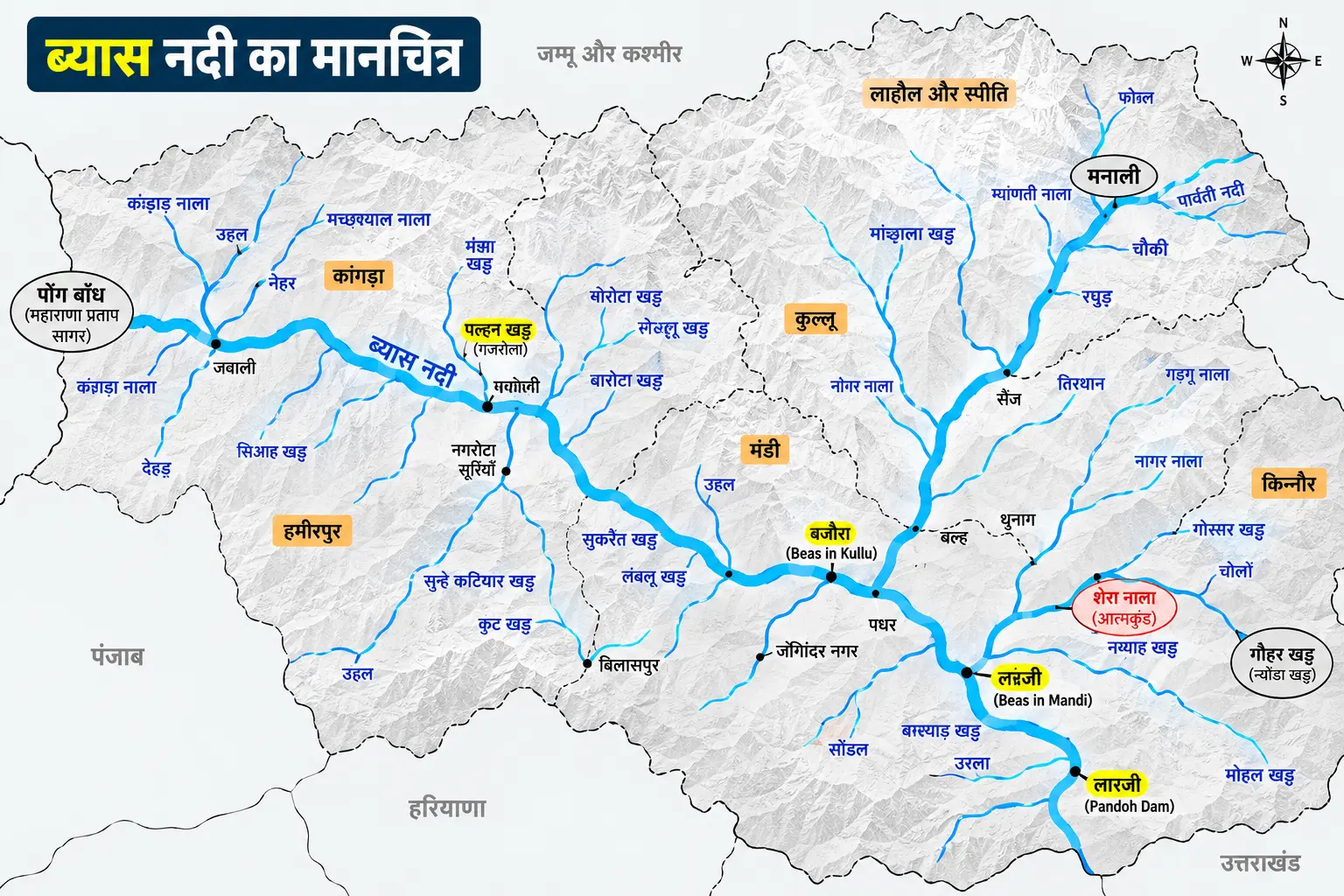
The Beas River originates from Beas Kund in the Pir Panjal range near the Rohtang Pass. It intersects the Dhauladhar mountain ranges at Larji and flows through the world-famous valleys of Kullu and Kangra.
The Vedic name of the Beas is Arjikiyā and its Sanskrit name is Vipasha. The famous tourist resort of Manali is situated on the right bank of the river.
Its total length is about 470 km, of which about 256 km flows through central Himachal Pradesh.The Beas river and its tributaries are important for Himachal Pradesh competitive exams.
Beas River at a Glance
Origin and Course of Beas River
The Beas originates at Beas Kund near Rohtang Pass and flows through the Kullu and Kangra valleys. The sequence below presents the major stages of its course and the important places associated with the river in an exam-focused format.
Beas Kund, Pir Panjal
The Beas River originates from Beas Kund in the Pir Panjal range near the Rohtang Pass.
Rohtang Pass to Manali
From its high-altitude source region, the Beas flows towards Manali. The famous tourist resort of Manali is situated on the right bank of the river.
Manali to Kullu
From Manali, the Beas reaches the town of Kullu after passing through dense evergreen forests. Important settlements along this section include Naggar, Katrain, Ralson and Kullu.
Dhauladhar Intersection
The Beas intersects the Dhauladhar mountain ranges at Larji. The Larji region is also important because tributaries such as Sainj and Tirthan are associated with this part of the Beas basin.
Pandoh and Mandi
The river continues through the Mandi region, with Pandoh and Mandi among the important settlements associated with its course.
Sandhol and Lower Course
At Sandhol, the Beas enters Kangra. The river continues through the lower Beas region, with Nadaun and Sujanpur among the important settlements along its banks.
Banjaura and Tributary Confluences
At Banjaura, the Beas enters the Mandi district. Several small rivulets join the river in this region, including Hansa, Tirthan, Bakhli, Jiuni, Suketi, Panddi, Son and Bather.
Mirthal
At Mirthal, the Beas River enters the plain areas. This marks an important transition in the lower course of the river.
Important Settlements Along the Beas
These settlements are specifically important for HP Geography questions because they occur along the Beas river corridor.
Tributaries of Beas River
The Beas has an extensive tributary system draining the Dhauladhar, Pir Panjal and Himalayan regions. The tributaries below are the important rivers and streams identified in the Beas study material.
Awa River
The Awa originates from the Dhauladhar range in Kangra valley. Before joining the Beas, it flows in a south-westerly direction and receives both snow and rain water from smaller streams.
Banner River
Also known as Baner Khad, the Banner River rises as a small snow-fed channel on the southern slopes of the Dhauladhar near Palampur. It drains the central Kangra valley.
Banganga River
The Banganga rises from the southern slopes of the Dhauladhar range and joins the Beas in the Kangra valley. It is fed by snow-melt waters and springs.
Chakki River
The Chakki originates from the southern slopes of the Dhauladhar range. It flows through the south-western part of the state and is fed by snow and rain. It joins the Beas near Pathankot.
Gai Khad
Gai Khad originates from the southern slopes of the Dhauladhar range in Kangra district. It merges with the Beas a little upstream of the Pong Dam lake (Maharana Pratap Sagar).
Luni River
The Luni originates from the southern slopes of the Dhauladhar range in Kangra valley. The central part of Kangra valley is the meeting point of the Luni and the Beas.
Uhl River
The Uhl originates from a lake formed by the Thamsar glacier in the higher Dhauladhar. It flows along the base of the Dhauladhar and then turns south-east to merge with the Beas near Mandi.
Manuni River
The Manuni originates from the southern slopes of the Dhauladhar range and joins the Beas. Its upper catchment consists of steep slopes. A sharp fall in gradient has produced large river terraces on both sides of its river bed, which are used for cultivation.
Parbati River
The Parbati originates from the snowy upstream of Mantalai Lake near Manikaran, on the foothills of the main Himalayan range in Kullu district. It meets the Beas at Shamshi in Kullu valley.
Sainj River
The Sainj originates from the water divide of the Beas and Satluj rivers in the lower ranges of the main Himalayas to the east of Kullu. It flows south-west and joins the Beas after cutting across the Dhauladhar near Larji.
Harla River
The Harla rises as a small channel from snow in the depression of the north-western part of Kullu valley. It joins the Beas near Bhuntar.
Suketi River
The Suketi originates from the south-facing slopes of the Dhauladhar range. It is formed by a number of small channels which join in its upper reaches. Terraces formed by the river are under cultivation.
Tirthan River
The Tirthan originates from the base of an offshoot of the Great or Main Himalayan Range to the south-east of Kullu. After cutting across the Dhauladhar, it takes a south-westerly course and finally meets the Beas at Larji.
Beas Tributaries — Exam Classification
A useful way to revise the Beas tributaries is to group them according to the mountain systems from which they originate.
Southern Dhauladhar Tributaries
Several tributaries of the Beas originate from the southern slopes of the Dhauladhar range.
Kullu & Himalayan Tributaries
The upper Beas basin receives important tributaries from the Himalayan and Kullu region.
Uhl River
The Uhl has a distinct source association with a lake formed by the Thamsar glacier in the higher Dhauladhar range.
Important Tributary–Place Connections
These combinations are particularly useful for objective-type questions in HPPSC, HPRCA and HP Patwari examinations.
Shamshi
Parbati meets the Beas at Shamshi in Kullu valley.
Larji
Sainj joins the Beas after cutting across the Dhauladhar near Larji.
Larji
Tirthan finally meets the Beas at Larji.
Bhuntar
Harla joins the Beas near Bhuntar.
Mandi
Uhl turns south-east and merges with the Beas near Mandi.
Pathankot
Chakki joins the Beas near Pathankot.
Important Beas River Facts
Quick revision points covering the facts most useful for understanding and revising the Beas River for Himachal Pradesh competitive examinations.
The Beas originates from Beas Kund in the Pir Panjal range.
Beas Kund, the source of the river, is near Rohtang Pass.
The Beas intersects the Dhauladhar mountain ranges at Larji.
The Vedic name of the Beas is Arjikiyā.
The Sanskrit name of the Beas is Vipasha.
The total length of the Beas is about 470 km.
About 256 km of the river flows through central Himachal Pradesh.
The Beas flows through the famous Kullu and Kangra valleys.
At Sandhol, the Beas enters Kangra.
At Mirthal, the Beas enters the plain areas.
Beas River in 30 Seconds
Use this final revision sheet after studying the detailed sections above.
Test Your Beas River Knowledge
Practice topic-wise HP Geography MCQs covering the origin, course, important settlements, tributaries and important Beas River facts.
Beas River MCQs — Coming SoonFrequently Asked Questions
Where does the Beas River originate?
The Beas River originates from Beas Kund in the Pir Panjal range near Rohtang Pass.
What is the Vedic name of the Beas River?
The Vedic name of the Beas River is Arjikiyā.
What is the Sanskrit name of the Beas River?
The Sanskrit name of the Beas River is Vipasha.
What is the total length of the Beas River?
The total length of the Beas River is about 470 km.
How much of the Beas flows through Himachal Pradesh?
The Beas flows for about 256 km through central Himachal Pradesh according to the supplied study material.
Which major valleys does the Beas flow through?
The Beas flows through the famous Kullu and Kangra valleys.
Which important tributary meets the Beas at Shamshi?
The Parbati River meets the Beas at Shamshi in Kullu valley.
Which tributary meets the Beas at Larji?
The Tirthan River finally meets the Beas at Larji. The Sainj also joins the Beas in the Larji area.
Which tributary joins the Beas near Bhuntar?
The Harla River joins the Beas near Bhuntar.
Which tributary joins the Beas near Mandi?
The Uhl River joins the Beas near Mandi.
At which place does the Beas enter Kangra?
According to the supplied study material, the Beas enters Kangra at Sandhol.
At which place does the Beas enter the plain areas?
The Beas enters the plain areas at Mirthal.