
The Census provides comprehensive information about the state’s population, literacy, sex ratio, population density, urbanization, Scheduled Castes (SC), Scheduled Tribes (ST), workforce, language, religion, and district-wise demographic characteristics. These statistics are essential for planning government policies, resource allocation, socio-economic development, and public welfare programmes.
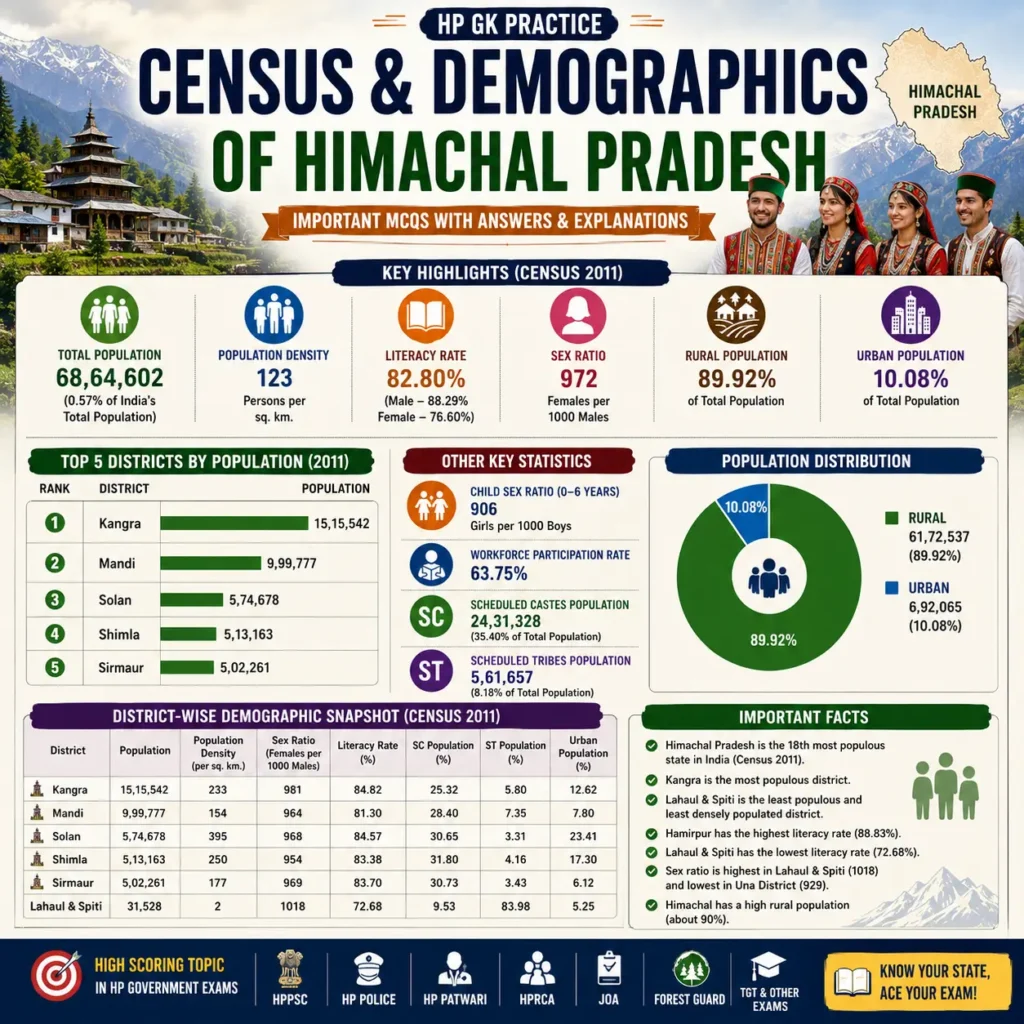
According to the Census of India 2011, Himachal Pradesh has a total population of 6,864,602, making it one of the least populated states in India. The state has a population density of 123 persons per square kilometre, significantly lower than the national average. The overall literacy rate is 82.80%, placing Himachal Pradesh among the most literate states in the country. The sex ratio stands at 972 females per 1,000 males, which is higher than the national average recorded in the 2011 Census. Rural residents account for approximately 90% of the population, reflecting the predominantly agrarian nature of the state. These demographic characteristics play a vital role in understanding Himachal Pradesh’s social and economic structure.
Himachal Pradesh consists of 12 districts, each having distinct demographic characteristics. Districts such as Kangra have the highest population, while Lahaul and Spiti have the lowest population density due to their harsh mountainous terrain and cold desert climate. Similarly, districts differ significantly in terms of literacy, sex ratio, Scheduled Tribe population, urbanization, and workforce participation, making district-wise demographic data an important area for competitive examinations.
The Census and Demographics of Himachal Pradesh form one of the most important topics in Himachal Pradesh General Knowledge (HP GK). This practice set contains exam-oriented MCQs covering the population, literacy, sex ratio, district-wise statistics, Scheduled Castes, Scheduled Tribes, languages, religions, workforce, rural-urban distribution, and important census facts of Himachal Pradesh. Every question includes the correct answer, detailed explanation, and an additional exam fact, making it an ideal resource for quick revision and competitive examination preparation.
Importance of Census & Demographics of Himachal Pradesh for HP Government Exams
The Census and Demographics of Himachal Pradesh are among the most frequently tested topics in the Geography, Society, Economy, and Current Affairs sections of HP Government examinations. Questions from this topic regularly appear in HPPSC, HP Police, HP Patwari, HPRCA, JOA, Naib Tehsildar, Forest Guard, TGT, and other recruitment examinations.
Examiners commonly ask questions on:
- 👥 Total population
- 📍 Most and least populated districts
- 📚 Literacy rate and district-wise literacy
- 👩 Sex ratio and child sex ratio
- 🏘️ Rural and urban population
- 📊 Population density
- 🗺️ District-wise demographic rankings
- 🏛️ Scheduled Castes and Scheduled Tribes population
- 🗣️ Major languages and dialects
- 🙏 Religious composition
- 💼 Workforce participation rate
- 📈 Census year and important demographic trends
Some of the most frequently asked exam facts include:
- Population (2011 Census): 6,864,602
- Number of Districts: 12
- Literacy Rate: 82.80%
- Sex Ratio: 972 females per 1,000 males
- Population Density: 123 persons per sq. km
- Most Populous District: Kangra
- Least Populous District: Lahaul & Spiti
- Highest Literacy District: Hamirpur
- Lowest Population Density: Lahaul & Spiti
- Largest Scheduled Tribe Population: Lahaul & Spiti and Kinnaur (districts with significant ST concentration)
Since these questions are fact-based, straightforward, and frequently repeated, this topic is regarded as one of the highest-scoring sections in HP GK. Aspirants who remember the key statistics and district-wise rankings can score valuable marks with minimal effort.
Exam Tip:
Revise every demographic fact using this simple sequence:
Indicator → State Value → Highest District → Lowest District → Important Fact
This approach covers the majority of questions asked in HP Government examinations.
Test Your Knowledge
Are you ready to test your preparation? Dive into the 15 highly anticipated multiple-choice questions below and see how many you can get right!
Key Facts Recap
📲 Get Daily HP GK Updates
Join our WhatsApp channel for daily HP GK MCQs, HPRCA job alerts & exam updates
Join WhatsApp ChannelRelated Pages:
➡️ Rivers of Himachal Pradesh – Complete Guide