

HP Daily GK brings you 30 important exam-oriented GK questions for HPPSC, HP Patwari, HP Police, HP Clerk, and other HP Government exams. The HP GK questions are in both English and Hindi. The candidates preparing for HP Patwari must practice these multiple choice questions as they are based purely on HP Patwari exam syllabus.
📘 Current GK Topic: Indian National Freedom Movements (as per HP Patwari Syllabus)
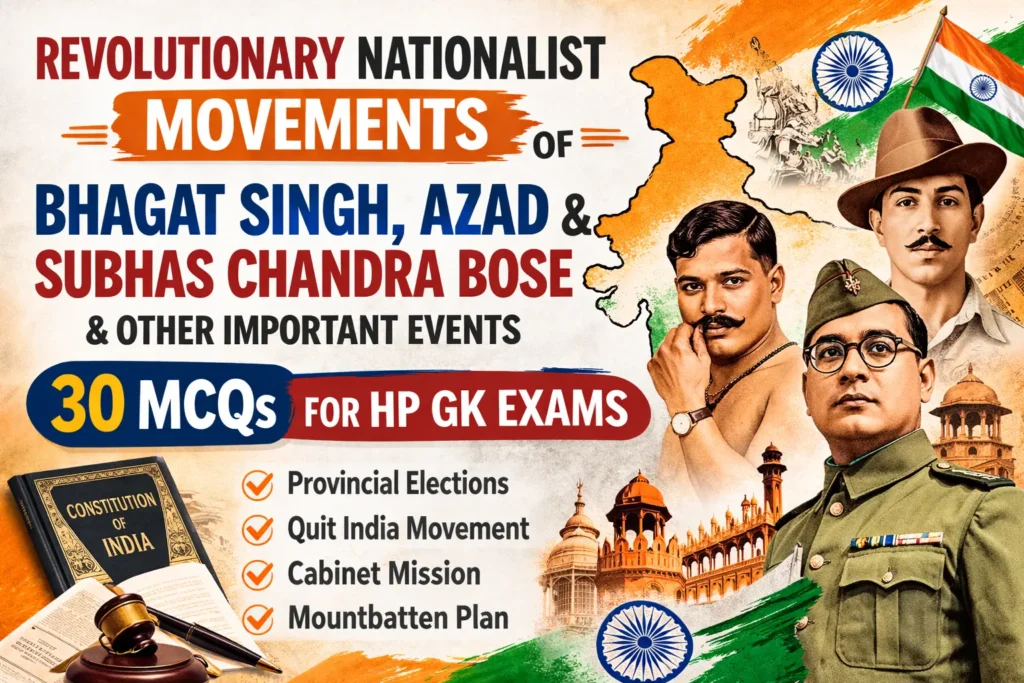
Late Phase of the Indian National Freedom Movement – Important Events & MCQs for HP GK Exams
The late phase of the Indian National Freedom Movement (1930–1947) played a decisive role in ending British colonial rule in India. During this period, revolutionary nationalism, mass movements, political negotiations, and constitutional proposals shaped the final struggle for independence. For competitive exams like HP Patwari, HP GK Exams, SSC, and State PSC, questions are frequently asked about important revolutionary leaders, political proposals, negotiations between Indian leaders and the British government, and the events that eventually led to the partition and independence of India in 1947.
Revolutionary nationalists such as Bhagat Singh and Chandrashekhar Azad inspired young Indians with their courage and sacrifice. Bhagat Singh, associated with the Hindustan Socialist Republican Association (HSRA), became a symbol of revolutionary patriotism after the Central Legislative Assembly bombing (1929) and his execution in 1931. Similarly, Chandrashekhar Azad, another key revolutionary leader, devoted his life to the freedom struggle and died in Alfred Park, Allahabad (1931) while fighting the British police.
Another prominent leader of this period was Subhas Chandra Bose, who believed in armed struggle against British rule. He organized the Indian National Army (INA) and established the Provisional Government of Free India (Azad Hind Government) in 1943. His famous slogan, “Give me blood and I will give you freedom,” motivated thousands of Indians to join the fight for independence.
During the 1930s and 1940s, several constitutional developments and negotiations took place between the British government and Indian leaders. The Government of India Act 1935 introduced provincial autonomy, leading to the Provincial Elections of 1937. Later, during World War II, the British government made several proposals such as the August Offer (1940) and the Cripps Mission (1942) in an attempt to secure Indian cooperation in the war.
One of the most significant mass movements during this period was the Quit India Movement launched by Mahatma Gandhi in 1942, with the powerful slogan “Do or Die.” This movement marked the final mass uprising against British rule.
As independence approached, several political negotiations were held, including the Wavell Plan (1945) and the Shimla Conference (1945). Later, the Cabinet Mission (1946) attempted to propose a constitutional framework for India. However, growing communal tensions and the demand for Pakistan eventually led to the Mountbatten Plan (1947), which resulted in the partition of India and independence on 15 August 1947.
Understanding these events is extremely important for competitive exams because questions are frequently asked from revolutionary leaders, major political proposals, important conferences, and the final steps leading to Indian independence.
Quick Overview – National Freedom Movement
| Year | Event | Key Personality |
|---|---|---|
| 1929 | Central Legislative Assembly Bombing | Bhagat Singh |
| 1931 | Death of Chandrashekhar Azad | Chandrashekhar Azad |
| 1937 | Provincial Elections | Government of India Act 1935 |
| 1940 | Lahore Resolution (Demand for Pakistan) | Muslim League |
| 1940 | August Offer | Lord Linlithgow |
| 1942 | Cripps Mission | Stafford Cripps |
| 1942 | Quit India Movement | Mahatma Gandhi |
| 1945 | Wavell Plan & Shimla Conference | Lord Wavell |
| 1946 | Cabinet Mission | British Government |
| 1947 | Mountbatten Plan | Lord Mountbatten |
Key Takeaways for HP Patwari / HP GK Exams
✔ Bhagat Singh and Chandrashekhar Azad were leading revolutionary nationalists associated with the HSRA.
✔ Subhas Chandra Bose formed the Indian National Army (INA) and the Azad Hind Government in 1943.
✔ Provincial Elections of 1937 were held under the Government of India Act 1935.
✔ The Quit India Movement (1942) was the final mass movement against British rule.
✔ Political negotiations such as the Wavell Plan, Shimla Conference, Cabinet Mission, and Mountbatten Plan led to India’s independence and partition in 1947.
The following MCQs will help you revise these crucial events quickly and strengthen your preparation for HP Patwari and other competitive exams.
⏱️ Time Suggested: 30 Minutes
📘 Level: 10+2 Level
🎯 Useful For: HPPSC, HPRCA HP Patwari, HP Police, HP Clerk, TET
National Freedom Movement – 30 MCQs (HP GK Exams)
Q1. Bhagat Singh belonged to which revolutionary organization?
भगत सिंह किस क्रांतिकारी संगठन से जुड़े थे?
A. Ghadar Party
B. Hindustan Socialist Republican Association
C. Anushilan Samiti
D. Indian National Army
A. गदर पार्टी
B. हिंदुस्तान सोशलिस्ट रिपब्लिकन एसोसिएशन
C. अनुशीलन समिति
D. आज़ाद हिंद फौज
Q2. Bhagat Singh and Batukeshwar Dutt threw bombs in which assembly?
भगत सिंह और बटुकेश्वर दत्त ने किस सभा में बम फेंका था?
A. Central Legislative Assembly
B. Lahore Assembly
C. Delhi Durbar
D. Bengal Assembly
A. केंद्रीय विधान सभा
B. लाहौर विधानसभा
C. दिल्ली दरबार
D. बंगाल विधानसभा
Q3. Chandrashekhar Azad was associated with which revolutionary group?
प्रश्न 3. चंद्रशेखर आज़ाद किस क्रांतिकारी संगठन से जुड़े थे?
A. HSRA B. Ghadar Party
C. Muslim League D. Swaraj Party
A. एचएसआरए B. गदर पार्टी
C. मुस्लिम लीग D. स्वराज पार्टी
Q4. Chandrashekhar Azad died in which place?
चंद्रशेखर आज़ाद की मृत्यु कहाँ हुई?
A. Allahabad (Alfred Park)
B. Lahore
C. Delhi
D. Kanpur
A. इलाहाबाद (अल्फ्रेड पार्क)
B. लाहौर
C. दिल्ली
D. कानपुर
Q5. Subhas Chandra Bose founded which army during World War II?
सुभाष चंद्र बोस ने द्वितीय विश्व युद्ध के दौरान किस सेना की स्थापना की?
A. Azad Hind Fauj
B. Red Army
C. Hindustan Republic Army
D. Ghadar Army
A. भारतीय राष्ट्रीय सेना
B. आज़ाद हिंद फौज
C. A और B दोनों
D. गदर सेना
Q6. The slogan “Give me blood, and I will give you freedom” was given by?
“तुम मुझे खून दो, मैं तुम्हें आज़ादी दूँगा” का नारा किसने दिया?
A. Gandhi B. Subhas Chandra Bose
C. Bhagat Singh D. Lala Lajpat Rai
A. गांधी B. सुभाष चंद्र बोस
C. भगत सिंह D. लाला लाजपत राय
Q7. The provincial elections in British India were held under which Act?
ब्रिटिश भारत में प्रांतीय चुनाव किस अधिनियम के अंतर्गत हुए?
A. Government of India Act 1919
B. Government of India Act 1935
C. Indian Councils Act 1909
D. Regulating Act 1773
A. भारत सरकार अधिनियम 1919
B. भारत सरकार अधिनियम 1935
C. भारतीय परिषद अधिनियम 1909
D. रेगुलेटिंग एक्ट 1773
Q8. The provincial elections in British India were held in which year?
ब्रिटिश भारत में प्रांतीय चुनाव किस वर्ष हुए?
A. 1935 B. 1937
C. 1942 D. 1946
A. 1935 B. 1937
C. 1942 D. 1946
Q9. The August Offer was announced in which year?
अगस्त प्रस्ताव किस वर्ष घोषित किया गया?
A. 1939 B. 1940
C. 1942 D. 1945
A. 1939 B. 1940
C. 1942 D. 1945
Q10. The August Offer was announced by which Viceroy?
अगस्त प्रस्ताव किस वायसराय ने घोषित किया?
A. Lord Linlithgow B. Lord Wavell
C. Lord Irwin D. Lord Mountbatten
A. लॉर्ड लिनलिथगो B. लॉर्ड वेवेल
C. लॉर्ड इरविन D. लॉर्ड माउंटबेटन
Q11. The demand for Pakistan was formally made in?
पाकिस्तान की मांग औपचारिक रूप से कब की गई?
A. 1937 B. 1940
C. 1942 D. 1946
A. 1937 B. 1940
C. 1942 D. 1946
Q12. The Lahore Resolution demanding Pakistan was passed पाकिस्तान की मांग वाला लाहौर प्रस्ताव किस वर्ष पारित हुआ?
A. 1938 B. 1940
C. 1942 D. 1945
A. 1938 B. 1940
C. 1942 D. 1945
Q13. The Cripps Mission came to India in?
क्रिप्स मिशन भारत कब आया?
A. 1940 B. 1941
C. 1942 D. 1945
A. 1940 B. 1941
C. 1942 D. 1945
Q14. The Cripps Mission was sent by which country?
क्रिप्स मिशन किस देश द्वारा भेजा गया था?
A. USA B. Britain
C. France D. Germany
A. अमेरिका B. ब्रिटेन
C. फ्रांस D. जर्मनी
Q15. The Quit India Movement was launched in?
भारत छोड़ो आंदोलन कब शुरू हुआ?
A. 1940 B. 1941
C. 1942 D. 1945
A. 1940 B. 1941
C. 1942 D. 1945
Q16. The Quit India Movement started from which place?
भारत छोड़ो आंदोलन कहाँ से शुरू हुआ?
A. Delhi B. Bombay
C. Lahore D. Calcutta
A. दिल्ली B. बॉम्बे (मुंबई)
C. लाहौर D. कोलकाता
Q17. The slogan “Do or Die” was given during which movement?
“करो या मरो” का नारा किस आंदोलन के दौरान दिया गया?
A. Civil Disobedience Movement
B. Quit India Movement
C. Non-Cooperation Movement
D. Swadeshi Movement
A. सविनय अवज्ञा आंदोलन
B. भारत छोड़ो आंदोलन
C. असहयोग आंदोलन
D. स्वदेशी आंदोलन
Q18. The C. Rajagopalachari Formula was related to?
सी. राजगोपालाचारी फॉर्मूला किससे संबंधित था?
A. Partition of India
B. Pakistan demand compromise
C. Land reforms
D. Civil Disobedience
A. भारत विभाजन
B. पाकिस्तान मांग पर समझौता
C. भूमि सुधार
D. सविनय अवज्ञा
Q19. The Wavell Plan was proposed in which year?
वेवेल योजना किस वर्ष प्रस्तावित हुई?
A. 1943 B. 1945
C. 1946 D. 1947
A. 1943 B. 1945
C. 1946 D. 1947
Q20. The Shimla Conference was held in?
शिमला सम्मेलन कब आयोजित हुआ?
A. 1943 B. 1945
C. 1946 D. 1947
A. 1943 B. 1945
C. 1946 D. 1947
Q21. The Cabinet Mission came to India in?
कैबिनेट मिशन भारत कब आया?
A. 1945 B. 1946
C. 1947 D. 1948
A. 1945 B. 1946
C. 1947 D. 1948
Q22. The Cabinet Mission was sent by which country?
कैबिनेट मिशन किस देश द्वारा भेजा गया था?
A. Britain B. USA
C. France D. Germany
A. ब्रिटेन B. अमेरिका
C. फ्रांस D. जर्मनी
Q23. The Cabinet Mission proposed the formation of?
कैबिनेट मिशन ने किसके गठन का प्रस्ताव रखा?
A. Constituent Assembly
B. Parliament
C. Senate
D. Council
A. संविधान सभा
B. संसद
C. सीनेट
D. परिषद
Q24. The Mountbatten Plan was announced in?
माउंटबेटन योजना कब घोषित हुई?
A. 1946
B. 1947
C. 1948
D. 1949
A. 1946
B. 1947
C. 1948
D. 1949
Q25. Who was the last Viceroy of India?
भारत का अंतिम वायसराय कौन था?
A. Lord Mountbatten
B. Lord Wavell
C. Lord Linlithgow
D. Lord Irwin
A. लॉर्ड माउंटबेटन
B. लॉर्ड वेवेल
C. लॉर्ड लिनलिथगो
D. लॉर्ड इरविन
Q26. The Mountbatten Plan led to?
माउंटबेटन योजना के परिणामस्वरूप क्या हुआ?
A. Partition of India
B. Independence only
C. Federal government
D. Provincial autonomy
A. भारत का विभाजन
B. केवल स्वतंत्रता
C. संघीय सरकार
D. प्रांतीय स्वायत्तता
Q27. The Indian Independence Act was passed in?
भारतीय स्वतंत्रता अधिनियम कब पारित हुआ?
A. 1946 B. 1947
C. 1948 D. 1949
A. 1946 B. 1947
C. 1948 D. 1949
Q28. India became independent on?
भारत कब स्वतंत्र हुआ?
A. 15 August 1947
B. 26 January 1950
C. 2 October 1947
D. 15 August 1948
A. 15 अगस्त 1947
B. 26 जनवरी 1950
C. 2 अक्टूबर 1947
D. 15 अगस्त 1948
Q29. The capital of Azad Hind Government was declared at?
आज़ाद हिंद सरकार की राजधानी कहाँ घोषित की गई थी?
A. Delhi B. Port Blair
C. Rangoon D. Singapore
A. दिल्ली B. पोर्ट ब्लेयर
C. रंगून D. सिंगापुर
Q30. Subhas Chandra Bose formed the Provisional Government of Free India in?
सुभाष चंद्र बोस ने आज़ाद हिंद सरकार कब बनाई?
A. 1941 B. 1942
C. 1943 D. 1944
A. 1941 B. 1942
C. 1943 D. 1944
Answers:
1-B, 2-A, 3-A, 4-A, 5-C,
6-B, 7-B, 8-B, 9-B, 10-A
11-B, 12-B, 13-C, 14-B, 15-C, 16-B, 17-B, 18-B, 19-B, 20-B
21-B, 22-A, 23-A, 24-B, 25-A, 26-A, 27-B, 28-A, 29-D, 30-C
🔗Important Links For You
👉 HP Patwari Exam Syllabus – Prepare with the updated syllabus
👉 Latest HP Government Jobs – Check today’s vacancies
👉 HP GK (Himachal Pradesh General Knowledge)
👉 Download Weekly GK PDF
📲 Join Our WhatsApp for Daily HP GK.
📢 Get Daily HP GK, exam alerts & PDF notes directly on WhatsApp.