
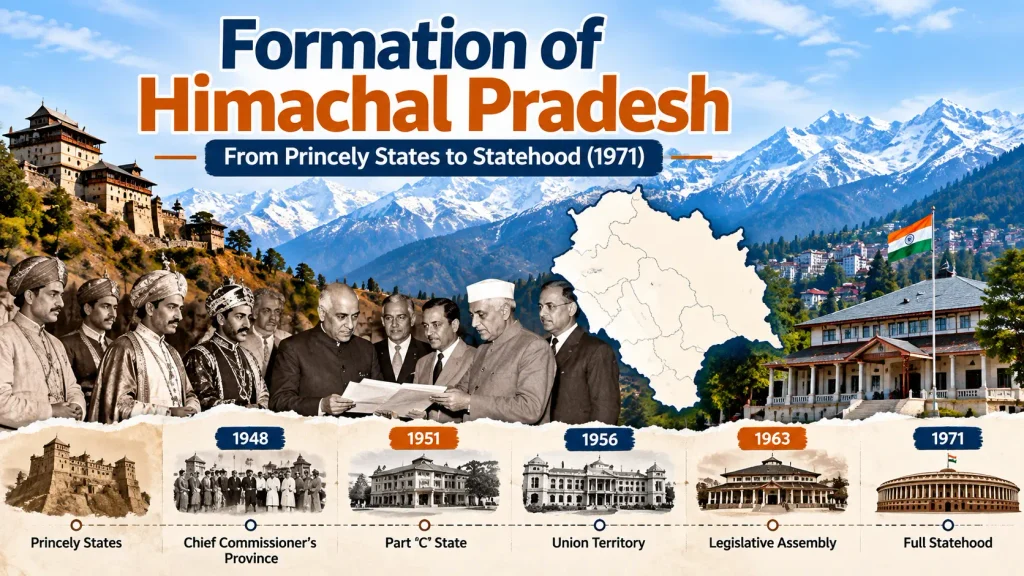
Formation of Himachal Pradesh
Learn how the hill states were integrated into Himachal Pradesh, how its constitutional and administrative status changed after independence, and how the state achieved full statehood in 1971.
Formation of Himachal Pradesh – Overview
Before the creation of Himachal Pradesh, the hilly areas were administered by various small and big rulers. There was lack of a parallel system of administration. The present area of Himachal once was conquered and captured by some thirty princely states. These states had different constitutional provisions and laws, which got place in the Indian Constitution after independence.
Himachal Pradesh Formation – Key Stages
Integration
Hill states were brought together and Himachal Pradesh became a Chief Commissioner’s Province.
Part ‘C’ State
Himachal Pradesh received Part ‘C’ State status.
Union Territory
Himachal Pradesh became a Union Territory.
Legislative Assembly
The Territorial Council was converted into a Legislative Assembly.
Reorganisation
Additional hill areas were merged after Punjab reorganisation.
Statehood
Himachal Pradesh became the 18th state of the Indian Union.
Integration of Princely States
During 1939, many Praja Mandals were formed in different princely states of the hilly region, including Chamba, Mandi, Bilaspur, Bushahr, Jubbal and Sirmaur. In order to bring the Praja Mandals together, the Himalayan Hill States Regional Council was formed in 1946 at Shimla, with the aim to establish an independent hill state.
After India got freedom, a demand was raised in some quarters for the merger of the hill states with East Punjab. This demand was opposed by both rulers and people, who considered the hill areas different in manners, customs, language and other aspects.
In January 1948, the rulers of Shimla hill states met in Delhi and decided to constitute a Shimla Hill States Union. Representatives were instructed to reach Solan on 26 January 1948 for the inaugural session of the constitution-making body.
Himalayan Prant Provisional Government
The Praja Mandals formed the Himalayan Prant Provisional Government on 27 January 1948 with the approval of the All India States People’s Council. It was headed by Shivanand Ramaul with its headquarters at Shimla.
In February 1948, it launched a Civil Disobedience Movement in Suket, also known as Suket Satyagraha. It was led by Pandit Padam Dev against the ruler of Suket in order to merge the state with the Indian Union. Thereafter, the Raja signed the accession document under public pressure and state administration was taken over by the Government of India.
Bhagmal Sautha submitted a memorandum to Sardar Vallabh Bhai Patel on 1 March 1948, highlighting the need to constitute the hilly regions into an independent state and merge it with the Indian Union.
Himachal Pradesh as Chief Commissioner’s Province
On 15 April 1948, Himachal Pradesh came under Chief Commissioner’s Province till 1951. It comprised 30 princely states with four districts: Chamba, Mandi, Sirmaur and Mahasu.
The Chief Commissioner’s Province was not fully democratic. It had an advisory body consisting of three erstwhile princely rulers and six representatives of the people.
Himachal Pradesh as Part ‘C’ State of India
In 1951, the Government of India enacted the Government of Part ‘C’ States Act. Himachal Pradesh was placed in Part ‘C’. The ten Part ‘C’ states were Ajmer, Bhopal, Bilaspur, Coorg, Delhi, Himachal Pradesh, Kutch, Manipur, Tripura and Vindhya Pradesh.
The Chief Commissioner was replaced by a Lieutenant Governor. In 1952, Himmat Singh became the first Lt. Governor of Himachal Pradesh. The Act also permitted an elected Assembly along with a Council of Ministers.
Himachal Pradesh as a Union Territory
On 1 November 1956, Himachal Pradesh became a Union Territory under an Administrator with the designation of Lieutenant Governor.
A Territorial Council with 43 members came into existence under the Union Territories Act. It had limited powers over health, education, animal husbandry and village roads up to district level.
The peaceful struggle of the people convinced the Indian Government that representatives of the people should be given responsibility for managing their own affairs.
Territorial Council of Himachal Pradesh
Territorial Council
- Education up to district level
- Village roads
- Bridges and buildings
- Superintendence and control of cooperatives
These subjects were administered by the Chairman with assistance from the Chief Executive Officer.
Lieutenant Governor
- Finance
- Appointments
- Judiciary
- Law and order
- Revenue
The Lieutenant Governor also acted as Administrator and was assisted by a Chief Secretary and secretaries.
Formation of Legislative Assembly
The system of Territorial Council and control of the Lieutenant Governor created confusion and disorder in the Union Territory. This created a demand for a full-fledged Legislature and Cabinet of Ministers.
The Government of India enacted the Government of Union Territories Act, 1963. The Himachal Territorial Council was converted into a Legislative Assembly on the recommendation of the Ashok Sen Committee.
On 1 July 1963, a three-member ministry was formed under Dr. Y.S. Parmar, along with Thakur Karan Singh and Hari Das. In 1963, the services of the Administration and Territorial Council were amalgamated.
Reorganisation of Himachal Pradesh
The question of reorganisation of Punjab was opened in 1965 by the Hukum Singh Committee. The Punjab hill people and Himachal people demanded the merger of the hilly areas of Punjab with Himachal Pradesh.
A memorandum was submitted by the Himachal Pradesh Government, Chief Minister and President of HPCC to the Hukum Singh Committee and Punjab Boundary Commission. It called for merger on the basis of commonality of language, culture and economic interests.
The formation of Vishal Himachal was realised when, after the recommendation of the Punjab Boundary Commission, Punjab was divided into Haryana and Punjab and the hilly regions were merged with Himachal Pradesh.
Status of Statehood
On 24 January 1968, the State Legislature under the leadership of Dr. Y.S. Parmar passed a resolution demanding statehood.
On 31 July 1970, the Bill for full-fledged statehood was sent before Parliament. On 18 December 1970, the Himachal Pradesh State Act was passed.
Himachal Pradesh became the 18th state of the Indian Union
It was inaugurated by Mrs. Indira Gandhi, then Prime Minister of India.
The supplied material states that S. Chakravarti served as the first Governor and Dr Yashwant Singh Parmar as the first Chief Minister of the state. On 1 September 1972, Una and Hamirpur were created as a result of trifurcation of Kangra. Solan was carved out of Solan and Arki tehsils of Mahasu district.
Formation of Himachal Pradesh Timeline
Important Facts About Formation of Himachal Pradesh
How to Study Formation of Himachal Pradesh
Learn the stages
Integration → Chief Commissioner’s Province → Part ‘C’ State → Union Territory → Legislative Assembly → Reorganisation → Statehood.
Memorise dates
Focus on 1948, 1951, 1954, 1956, 1963, 1966, 1970 and 1971.
Connect people & events
Revise Shivanand Ramaul, Padam Dev, Bhagmal Sautha and Dr Y.S. Parmar with their associated events.
Practice
After studying, test yourself with Formation of Himachal Pradesh MCQs.
Formation of Himachal Pradesh – FAQs
When did Himachal Pradesh become the 18th state of India?
According to the supplied study material, Himachal Pradesh became the 18th state of the Indian Union on 25 January 1971.
When did Himachal Pradesh become a Chief Commissioner’s Province?
Himachal Pradesh came under the Chief Commissioner’s Province on 15 April 1948.
When did Himachal Pradesh become a Union Territory?
Himachal Pradesh became a Union Territory on 1 November 1956.
When was Bilaspur merged with Himachal Pradesh?
Bilaspur was merged with Himachal Pradesh on 1 July 1954.
When was the Territorial Council converted into a Legislative Assembly?
The Territorial Council was converted into a Legislative Assembly on 1 July 1963 according to the supplied study material.
What happened on 1 November 1966?
Additional hill areas were merged with Himachal Pradesh as part of the reorganisation of Punjab.
Test Your Knowledge of Himachal Pradesh Formation
Revise the timeline, important personalities and constitutional stages, then practice objective questions.