

HP Daily GK brings you 10 important exam-oriented GK questions for HPPSC, HP Patwari, HP Police, HP Clerk, and other HP Government exams. The HP GK questions are in both English and Hindi.
📘 Current GK Topic: Indian History – Empires-Mauryan Empire (as per HP Patwari Syllabus)
The Mauryan Empire marks the beginning of large-scale political unity in ancient Indian history and is a core topic for HPPSC, HPRCA, UPSC, and State PCS exams.
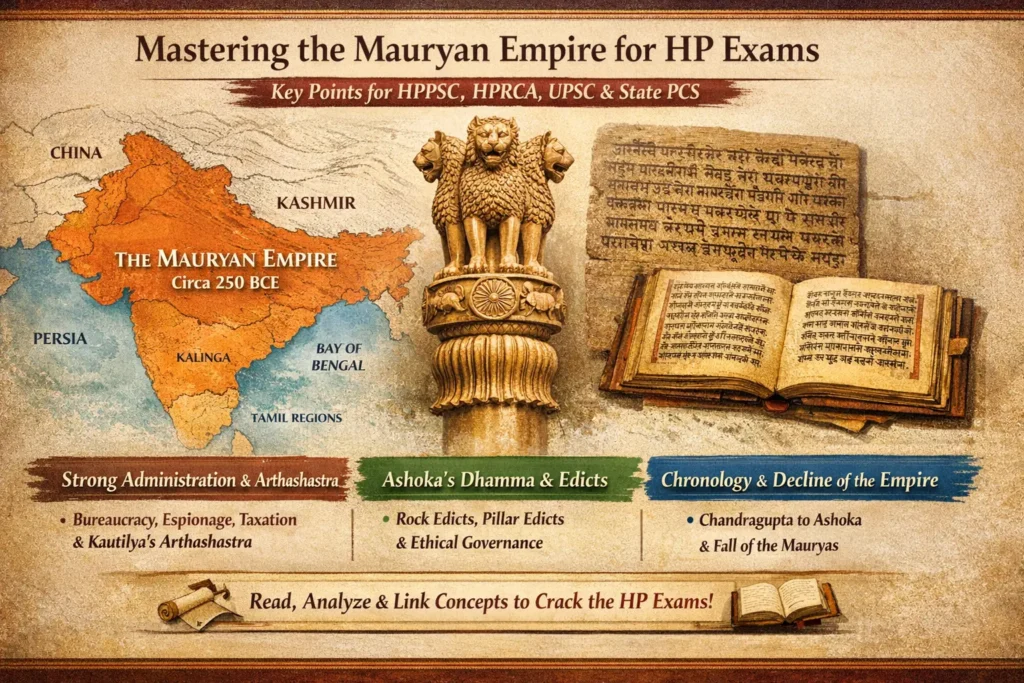
Founded in 322 BCE by Chandragupta Maurya, it was the first empire to unify most of the Indian subcontinent under a centralized administration.
From an exam-preparation perspective, the Mauryan period is important for multiple reasons:
- It laid the foundation of a strong administrative system, described in detail in the Arthashastra by Kautilya.
- It introduced a well-organized bureaucracy, provincial administration, espionage system, taxation, and standing army.
- The empire reached its greatest extent under Ashoka, whose reign is crucial for questions on Dhamma, inscriptions, pillars, and state policy.
Ashoka’s rule represents a turning point in Indian history, where state power was combined with ethical governance. His inscriptions are the earliest deciphered written records of India, making them extremely important for historical source–based questions. Topics like Rock Edicts, Pillar Edicts, Major and Minor Edicts, and their messages frequently appear in objective exams.
For HP exams, students should focus on:
- Chronology of Mauryan rulers
- Administrative divisions (Kendra–Ahara–Janapada model)
- Sources of Mauryan history (Archaeological & Literary)
- Ashoka’s Dhamma vs Buddhism
- Decline of the Mauryan Empire
Understanding the Mauryan Empire helps aspirants build conceptual clarity in Ancient History, which directly improves accuracy in MCQs, statement-based questions, and prelims scoring. The following daily questions are designed to test these high-yield areas from an examination point of view.
📘 Read carefully, think administratively, and link facts with concepts — this is the key to cracking HP exams.
🔗 Practice Daily GK here:
📅 Today’s HP GK Quiz
⏱️ Time Suggested: 10–12 Minutes
📘 Level: Easy
🎯 Useful For: HPPSC, Patwari, Police, Clerk, TET
Q1. Who was the founder of the Mauryan Empire?
मौर्य साम्राज्य का संस्थापक कौन था?
A) Bindusara
B) Ashoka
C) Chandragupta Maurya
D) Bimbisara
Q2. Who was the mentor of Chandragupta Maurya?
चंद्रगुप्त मौर्य के गुरु कौन थे?
A) Patanjali
B) Chanakya
C) Kalhana
D) Charaka
Q3. The Mauryan Empire’s capital was located at?
मौर्य साम्राज्य की राजधानी कहाँ थी?
A) Taxila
B) Pataliputra
C) Ujjain
D) Kaushambi
Q4. Which book was written by Chanakya?
चाणक्य द्वारा लिखी गई पुस्तक कौन-सी है?
A) Arthashastra
B) Manusmriti
C) Mahabhashya
D) Raghuvamsha
Q5. Who was Chandragupta Maurya’s successor?
चंद्रगुप्त मौर्य के उत्तराधिकारी कौन थे?
A) Ashoka
B) Bindusara
C) Dasharatha
D) Samprati
Q6. Which dynasty ruled after the Nandas?
नंद वंश के बाद किस वंश का शासन हुआ?
A) Gupta
B) Maurya
C) Shunga
D) Kanva
Q7. Which river flowed near Pataliputra?
पाटलिपुत्र के पास कौन-सी नदी बहती थी?
A) Yamuna
B) Ganga
C) Narmada
D) Godavari
Q8. Ashoka belonged to which dynasty?
अशोक किस वंश से संबंधित थे?
A) Gupta
B) Maurya
C) Shunga
D) Kushana
Q9. Who was the Greek ambassador at Mauryan court?
मौर्य दरबार में यूनानी राजदूत कौन था?
A) Megasthenes
B) Herodotus
C) Pliny
D) Ptolemy
Q10. Mauryan administration known for?
मौर्य प्रशासन किसके लिए प्रसिद्ध था?
A) Decentralization
B) Military rule
C) Centralized administration
D) Feudalism
Answers:
1-C, 2-B, 3-B, 4-A, 5-B, 6-B, 7-B, 8-B, 9-A, 10-C
🔗Important Links For You
👉 HP Patwari Exam Syllabus – Prepare with the updated syllabus
👉 Latest HP Government Jobs – Check today’s vacancies
👉 HP GK (Himachal Pradesh General Knowledge)
👉 Download Weekly GK PDF
📲 Join Our WhatsApp for Daily HP GK.
📢 Get Daily HP GK, exam alerts & PDF notes directly on WhatsApp.