
Soils of Himachal Pradesh
Study the major soil zones of Himachal Pradesh, their altitude, characteristics, distribution, agricultural importance, soil problems, erosion and conservation measures for HP competitive exams.
Soils of Himachal Pradesh
The soil in Himachal Pradesh varies from thin, bare soil of high mountains to rich, deep alluvial soil of the valleys. It’s formation is affected by altitude and climatic conditions of the region. At present, the soil resource in Himachal Pradesh is facing massive problems due to soil erosion.
In Himachal Pradesh, the different type of soils are formed by weathering of Sedimentary and Metamorphic rocks found in mighty Himalayan ranges. These weathered rocks combined with decomposition of plant and animal remains added to the formation of soil of different colours, texture and nutrients. The soil in Himachal Pradesh is divided according to the hill zones in which they are present.
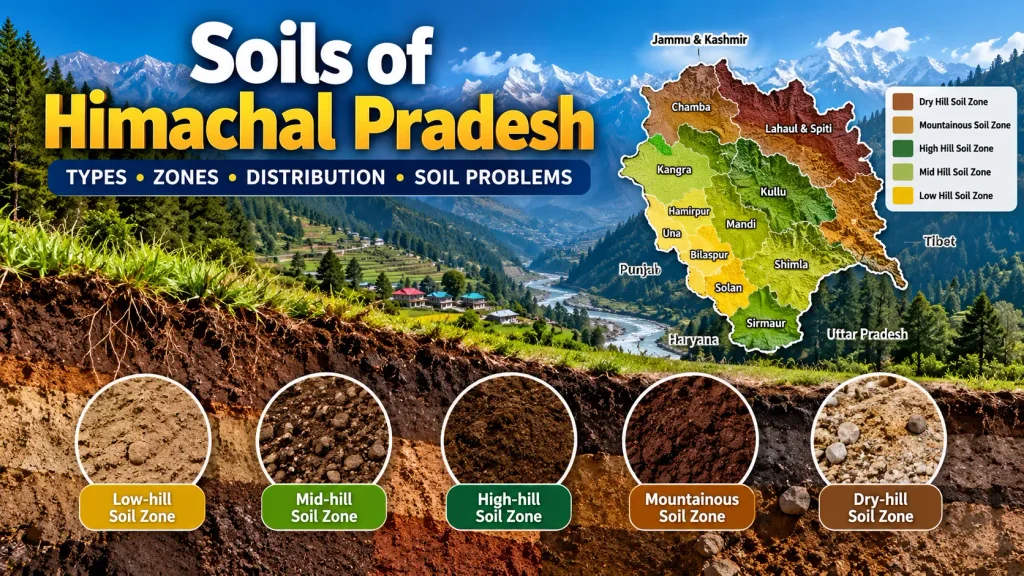
The soils found in Himachal Pradesh are diverse in character depending upon altitude, vegetation cover and structure. Soils of Himachal Pradesh can be classified on the basis of altitude and climate. There are six major zones which are as follows:
i. Low-hill Soil Zone
These soils are found up to 900-1000 m above sea level. This zone comprises of entire districts of Una, Hamirpur and some parts of Bilaspur, Kangra, Mandi, Paonta valley and Nahan area of Sirmaur, Kunihar area of Solan and Bhattiyat region of Chamba districts. The soil colour of this zone is light grey to brown. The soils of this zone are not very deep.
This zone mostly constitutes the soils situated on the banks of rivers and streams. The soil in this region is alluvial soil but with low organic matter and calcium carbonate. Its texture is sandy loam. The carbon and nitrogen ratio of soil in this zone is around 10 : 1. The soil of this zone is suitable for the cultivation of maize, wheat, rice, sugarcane crops and sub-tropical fruits like mango, litchi, guava, etc.
ii. Mid-hill Soil Zone
These soils are found at an altitude of 1000 m to 1500 m above sea level. This zone comprises of Arki in Solan, Palampur in Kangra district, Pachhad and Rainka tehsil of Sirmaur, Chamba, upper Bhattiyat tehsil, lower Churah and Dalhousie of Chamba and Jogindernagar area of Mandi.
The soil in this zone is known as podzolic soil. It’s texture is clayey loam and organic matter is medium. The soil colour of this zone is greyish to brown. The soils have varying percentage of pebbles (gravels) and stones. The reaction (pH) of the soil is neutral to acidic. The soil of this zone is suitable for the cultivation of maize, potatoes and stone fruits like peach, plum, apricot, pomegranate, etc. The carbon and nitrogen ratio of the soil in this zone increases as compared to low hill soil zone. Some amount of alluvial soil is also found in this zone.
iii. High-hill Soil Zone
These soils are found between 1500 m to 3000 m above sea level. This zone comprises of Chachiot and Karsog tehsil of Mandi, upper Shimla hills, upper areas of Pachhad and Rainka tehsil of Sirmaur and upper parts of Churah to Chamba district. This soil zone supports mixed deciduous forest and coniferous trees. The soils of this zone has fine texture and can vary from silty loam to clayey loam.
The soil colour of this zone is light to dark brown and hence also known as brown soil. The layer of these soils are very thick in nature. Fertility status of soil in this zone is quite high. The reaction of the soils of this zone are slightly acidic and soil erosion is the biggest problem of this zone. The soil of this zone is most suitable for the cultivation of temperate fruit production like apple, cherry, pear, etc.
iv. Mountainous Soil Zone
This zone constitutes the soils found at an elevation of 3000 m to 6000 m above sea level. This zone comprises of some parts of Shimla, Kangra and Kullu districts. The soils are silty loam to loam in texture and dark brown in colour. The soils of this zone are mostly under forest area and also known as forest soil. Soils of this zone are not good for agriculture but in some parts, apple is grown successfully. The reaction of the soil of this zone is slightly acidic to moderately acidic. Pine trees grow well in this soil.
v. Dry-Hill Soil Zone
This zone ranges from 6000 m above sea level. This zone comprises of Pangi tehsil of Chamba, Kinnaur and Lahaul and Spiti and Bharmour. Monsoon rainfall is almost negligible or minimal in this zone. The soils are mostly sandy-loam to loam and slightly alkaline in reaction. The soil lack nutrients like phosphorus, nitrogen, potassium, sulphur and zinc. The soils of this zone is suitable for the cultivation of dry fruits like almond, walnut, raisins, etc.
Classification of Soils of Himachal Pradesh
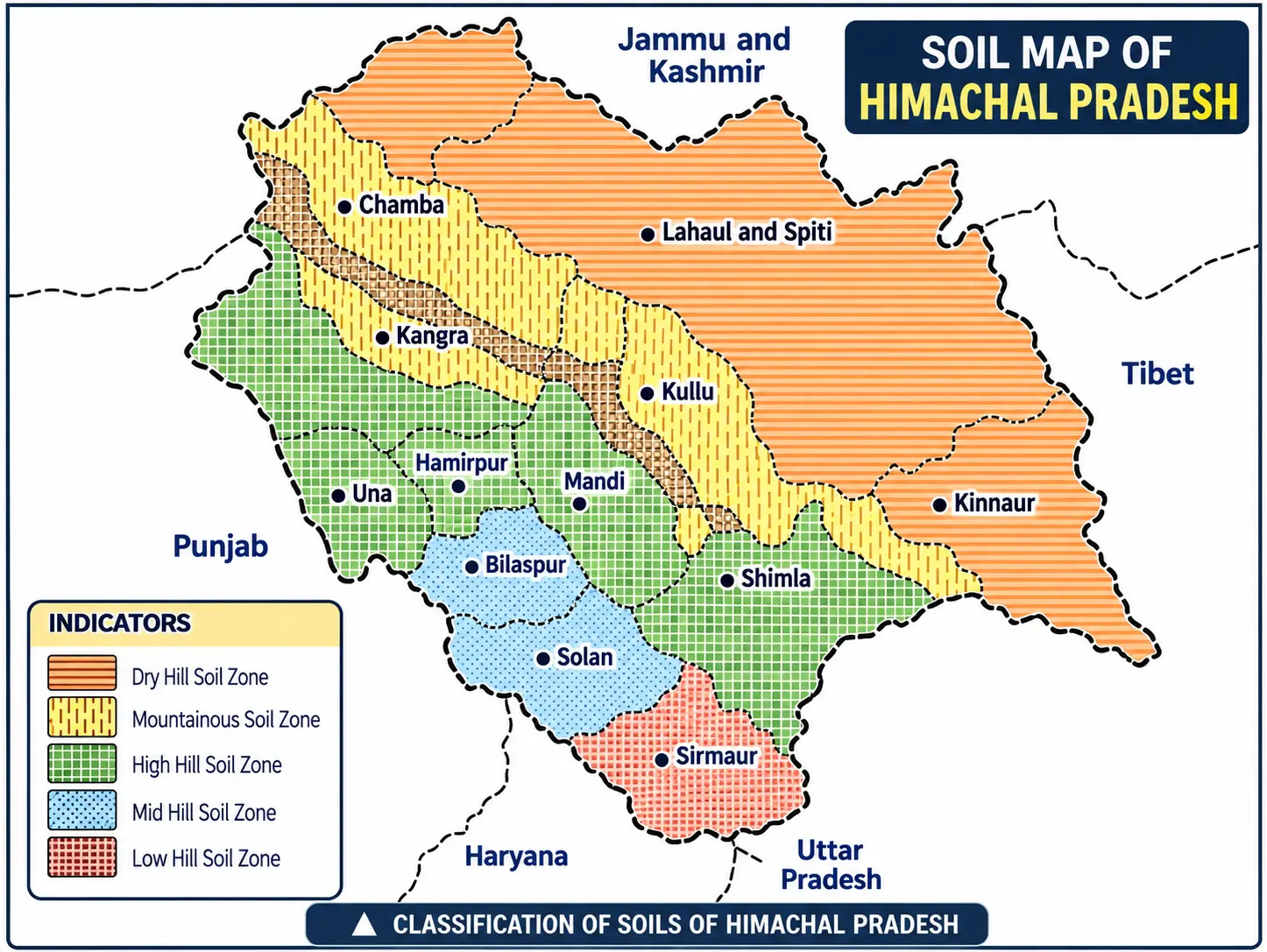
Soil Map – Regions Shown
States/Regions: Jammu and Kashmir, Chamba, Lahaul and Spiti, Kangra, Kullu, Hamirpur, Mandi, Una, Bilaspur, Shimla, Solan, Sirmaur, Punjab, Haryana, Uttar Pradesh and Tibet.
Legend: Dry Hill Soil Zone · Mountainous Soil Zone · High Hill Soil Zone · Mid Hill Soil Zone · Low Hill Soil Zone
Major Soil Problems in Himachal Pradesh
Problems of soils are as follows:
Acidity of Soils
Acidity in the soils is the major problem in the state. Acidic soils are mainly found in the districts of Kangra and Shimla, some parts of Chamba, Kullu and Mandi. Acidity has adverse effects on plant growth due to the toxic quantities of aluminium, iron and manganese. It is responsible for the low availability of calcium, magnesium, phosphorus and molybdenum.
Lack of Nutrients
Soils of Una and Hamirpur are low in nitrogen while soils of Kangra are low in phosphorus percentage. Other essential minerals like calcium carbonate is less in Sirmaur, Solan and Nahan. The lack of essential nutrients is also because of massive soil erosion.
Soil Erosion and Conservation
It is a slow phenomenon, causing extensive loss to soil fertility and damage to the land basin. In Himachal Pradesh, soil erosion has become a serious problem. About two-fifth of the state is under very high intensity erosion. Numerous streams erupt during the rainy season which causes the problem of run off, drainage over a large area and soil erosion.
Along with other development activities, deforestation, road construction, forest fires, etc are the basic reasons of the high soil erosion rate in the state. The sloping landscape also causes greater soil erosion and landslides. Other natural factors like variation in temperature, snowfall also results in thinning the texture of the soil which makes it prone to soil erosion.
Himachal Pradesh is a hilly terrain with rolling hill slopes. The high rainfall in the state add to the problems of soil erosion. Therefore certain measures are developed to prevent run offs.
Soil Testing Programmes
In order to maintain the fertility of the soil during each season, soil samples are collected from the farmer’s field and analysed in the soil testing laboratories. Soil testing laboratories have been established in all the districts (except Lahaul and Spiti). During 2010-11, two static soil testing labs have been strengthened and one mobile lab has been set-up at Palampur in Kangra district. At present many mobile soil testing vans and labs are working in the state.
Practice Himachal Pradesh Soil MCQs
Test your preparation with topic-wise Soil MCQs covering soil zones, characteristics, soil problems, erosion and conservation.