
Minerals of Himachal Pradesh
Study the important minerals of Himachal Pradesh, their distribution, uses, mineral map, mineral resources, policy objectives and issues related to illegal mining.
Mineral Resources of Himachal Pradesh
Nature has endowed Himachal Pradesh with a number of important minerals such as rock salt, gypsum, clays, mica, limestone, barytes, iron, pyrite and lead. Salt, limestone and slate are of significance. Limestone is the only mineral in the state which is found in abundance.
Himachal Pradesh roughly produces around 0.5% of the country’s mineral production. Most of the mineral resources are situated in the Shivalik range in the south-western part of the state. The state has many important minerals, though generally in lesser quantities.
Mineral Map of Himachal Pradesh
The mineral map shows the distribution and indicators of important mineral resources across Himachal Pradesh.
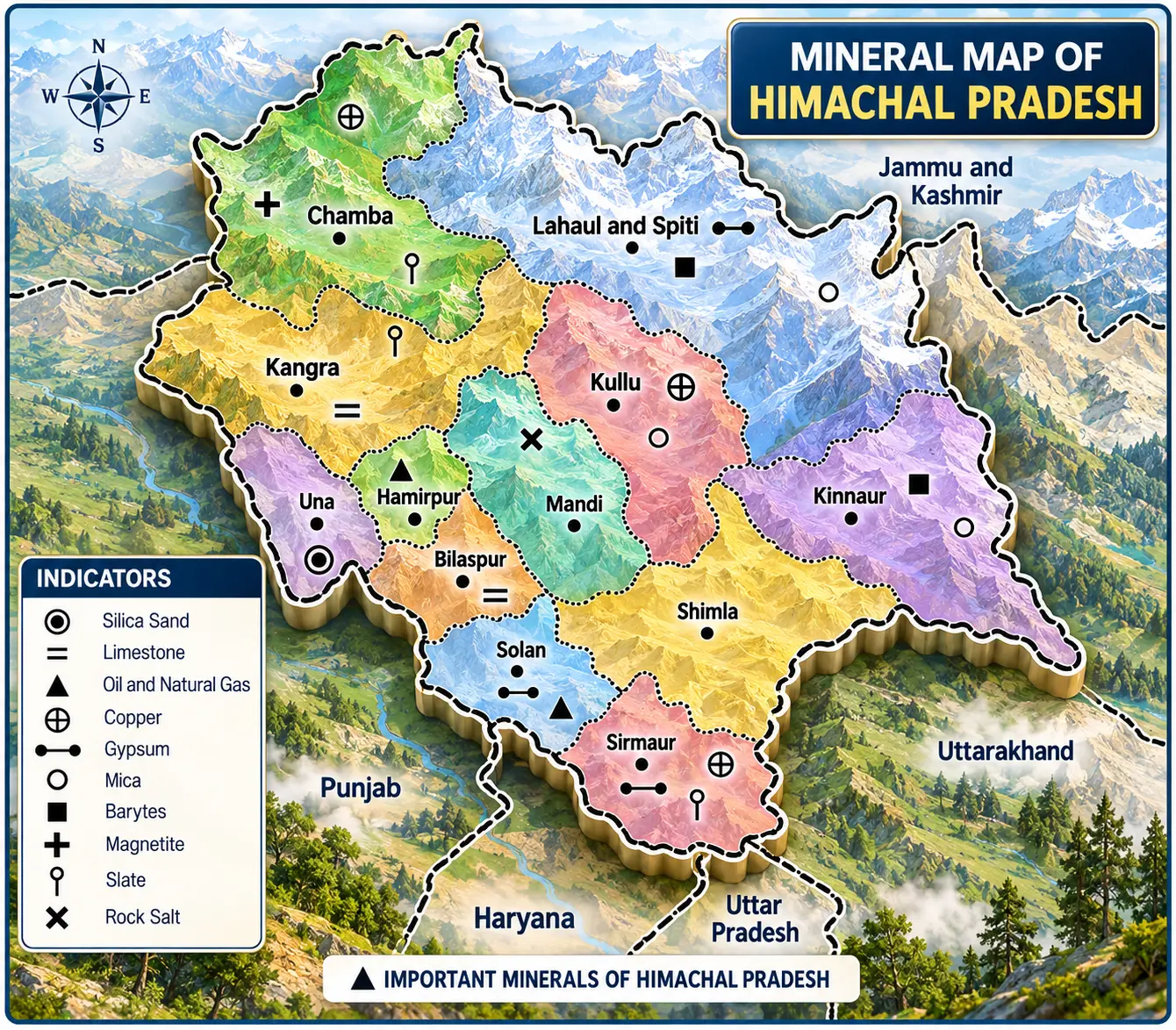
Mineral Map of Himachal Pradesh — important mineral occurrences and their distribution.
Map Indicators
Important Minerals of Himachal Pradesh
The following minerals are important from the perspective of distribution, uses and Himachal Pradesh geography examinations.
Limestone
Limestone is the most important mineral of Himachal Pradesh and is also found in abundance. It is used in the manufacturing of cement, chemicals, fertiliser, calcium carbide, sugar, paper and leather industries.
Limestone is mainly found in Barmana (Bilaspur), Gagal (Kangra), Solan, Mandi, Chamba (Broh, Sindh, Dhundiara), Kinnaur, Kullu and Shimla districts.
Limestone in Sirmaur
Important for cement manufacturing. A cement factory is established in Rajban.
Situated near Kamrao and Bharti regions. It contains dolomitic and granular limestone.
Situated at a height of 2150 m and contains good quality limestone with 96.5% calcium carbonate deposits.
Dolomitic Limestone
Dolomitic limestone is found in Panjota of Kotiphura block in Bilaspur. It is used for the production of calcium and ammonium nitrate in the Nangal fertiliser factory of Food Corporation of India.
Deposits are also found in Nalagarh city of Solan district and Karol of Sirmaur district.
Gypsum
Gypsum is mainly found in Rajban, Bharti and Korga areas of Sirmaur district, where the maximum concentration is found.
It is also found in Kuthar area of Solan district, but this is of low quality. Bhatri area of Chamba district also has gypsum deposits, but due to lack of mining and transportation facilities, they remain unutilised. Other areas of gypsum deposits include Lahaul and Spiti and Kinnaur districts.
Barytes
Barytes is mainly found in Sirmaur at Kanti, Mishwa-Talyana, Tiler Dhar and Dhala-Pipli, as well as in Lahaul and Spiti, Kinnaur, Solan and Shimla districts.
Barytes mines are located in the Kumla region.
Magnesite
Magnesite is mainly found in the Nacheter area of the Bharmour region of Chamba district. It is also found in the Sui region of Himachal Pradesh. The magnesite mineral ore found in these regions has 30% to 40% magnesite content.
Rock Salt
Himachal Pradesh is the only supplier of rock salt in the country according to the supplied material. It is found in the Gumma and Darang mining regions of Mandi district.
The region is under the control of the Central Government, which is trying to increase production in order to establish chemical industries.
Silica Sand
Ravines and rills of Una district have large amounts of bright boulders that can be crushed and used for manufacturing of lead, according to the supplied material. Important ravines mentioned are Parakva, Haroti, Homa and Bathuri.
Niari, Chenal and the Sutlej river valley are important areas of Bilaspur with bright white stone used for manufacturing of lead.
Slate
Himachal Pradesh has high-quality slate stone and is described in the supplied material as the leading producer of slate in the country. Mining is done mainly to fulfil local needs.
A factory has been established in Mandi for manufacturing slate tiles, which have demand in the country and the world. The demand has created possibilities for development of other factories in the region.
Slate is mainly found in Chamba, Sirmaur and Khaniara in Kangra district.
Oil and Natural Gas
Many places in Himachal Pradesh have possibilities for the availability of oil and natural gas deposits. Chaumukh region of Sundernagar and Renuka region near Nahan have evidence of oil in the region.
ONGC has proposed projects for oil extraction in the regions of Deotsidh in Hamirpur and Rameshwar in Solan district. Jwalamukhi region is also famous for the occurrence of natural gas.
Radioactive Minerals
Evidence of radioactive rocks has been found in Kullu, Kinnaur, Hamirpur and Shimla regions. Banjar town near Chhunjara and Jari region of Parvati valley show the possibility of availability of such minerals, as in Dheola of Garash valley.
Mineral Water
Mineral water is found in Bilaspur, Solan, Kangra and Shimla. Kalath village is famous for mineral water.
In the Manali region of Kullu district, natural mineral water resources contain sodium, magnesium, calcium chloride, sulphates, phosphates and iron.
Other Mineral Resources and Their Distribution
| Mineral | Districts / Locations |
|---|---|
| Mica | Kinnaur, Lahaul and Spiti and Kullu districts. |
| Iron ore | Mandi, Kullu and Kangra, Kinnaur, Lahaul and Spiti, Shimla and Sirmaur districts. |
| Coal | Solan, Kangra and Mandi districts. |
| Copper | Sirmaur, Kinnaur, Kullu, Chamba, Lahaul and Spiti and Solan districts. |
| Uranium | Hamirpur and Kullu districts. |
| Kyanite | Lahaul and Spiti, Kinnaur, Kullu. |
| Asbestos | Kangra, Mandi, Shimla districts. |
| Bauxite | Sirmaur, Solan, Shimla districts. |
| Gold | Bilaspur, Kangra, Kinnaur, Kullu, Mandi, Sirmaur districts. |
| Mineral | Districts / Locations |
|---|---|
| Lead | Kinnaur, Kullu, Lahaul and Spiti, Shimla, Sirmaur and Solan districts and found in Sutlej river. |
| Silver | Sirmaur, Kinnaur, Kullu. |
| Pyrite | Chamba and Shimla districts. |
| Cobalt | Lahaul and Spiti and Sirmaur districts. |
| Nickel | Kullu district. |
| Antimony | Lahaul and Spiti district. |
| Talc / Steatite | Shimla and Sirmaur. |
| Clay | Kangra, Kullu, Kinnaur, Mandi, Shimla, Sirmaur, Lahaul and Spiti. |
| Glass Sand | Bilaspur, Kangra, Una. |
Himachal Pradesh Mineral Policy
The state has been implementing new plans from time to time to meet present challenges. These include the hilly terrain of Himachal Pradesh, where mining considerations differ from the plains, ecological and environmental problems particular to the state, and the growing demand for minerals.
Main Objectives of the Mineral Policy
- To explore mineral wealth of the state by adopting modern exploration techniques.
- To take effective measures for checking unauthorised mining and leakage of revenue.
- To simplify and adequately modify Himachal Pradesh Minor Mineral Revised Rules, 1971.
- To adhere to the guidelines issued by the Ministry of Environment and Forest (MOEF), Government of India, for exploitation of minor minerals.
- To exploit mineral deposits by promoting mechanised and scientific mining with due regard to conservation of minerals, mine safety and environmental aspects.
- Value addition through promotion of processing units and mineral-based industries in the state.
- To increase employment opportunities in the mining sector, particularly in interior and remote areas of the state.
Problem of Illegal Mining
The state faces problems of illegal mining, leading to over-exploitation of mineral resources. It also leads to land degradation and disrupts the natural environment.
In 2015, under the state act on Prevention of Illegal Mining, Transportation and Storage, stringent punishment was ordered, including imprisonment of up to 2 years and a fine of ₹25,000. To end illegal stone quarrying in the Lesser Himalaya region, the supplied material states imprisonment of 2 years and a fine of ₹5 lakh.
These quarries provide building material to Shimla and Kangra.
Mining Limits
Quick Revision: Minerals of Himachal Pradesh
Test Your Knowledge of HP Minerals
Revise mineral distribution, important locations, mineral uses and exam-focused facts through practice questions.