
Climate of Himachal Pradesh
Study the climatic zones, seasons, rainfall regions and climate change patterns of Himachal Pradesh with exam-focused facts and revision points.
Climate of Himachal Pradesh – Overview
The state of Himachal Pradesh lies in the mountainous region with elevation levels ranging from 300 to 7,000 metres. The climatic conditions therefore vary from Sub-tropical to Semi-Arctic. The temperature and rainfall vary accordingly. Some places in the state experience severe winters while some have a pleasant climate during summers.
The climate of Himachal Pradesh depends upon geographical factors such as its location in the Himalayan mountain ranges, level of elevation (height/altitude of the area), latitudinal position, etc. The climate of the state is divided into various climatic zones.
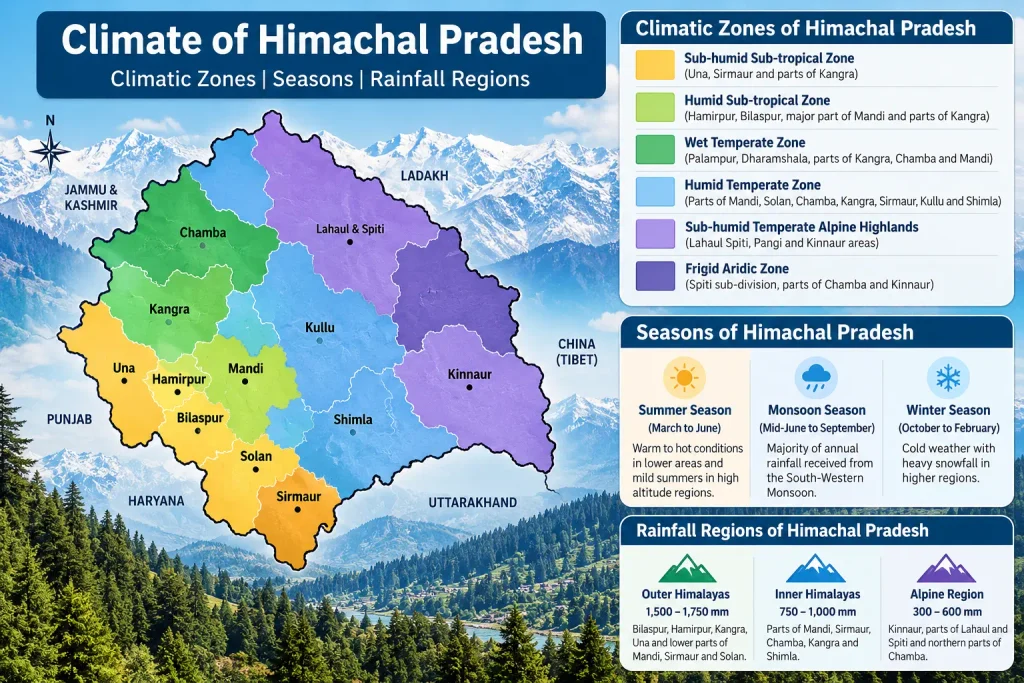
Climatic Zones of Himachal Pradesh
The state is divided into six climatic zones:
Sub-humid Sub-tropical Zone
This zone covers Una and Sirmaur districts and some parts of Kangra district.
- Mean annual temperature: 24°C
- Mean annual precipitation: 1,000 mm
Humid Sub-tropical Zone
This zone covers the whole of Hamirpur and Bilaspur districts, major parts of Mandi, Nahan of Sirmaur, and Nalagarh, Dehra Gopipur and Nurpur tehsils of Kangra.
- Mean annual temperature: 20–24°C
- Mean annual precipitation: 1,180–1,900 mm
Wet Temperate Zone
This zone comprises Palampur and Dharamshala areas of Kangra, Jogindernagar area of Chamba and Mandi district.
- Mean annual temperature: 15–19°C
- Mean annual rainfall: 2,500–3,900 mm
- Key fact: This zone receives the highest rainfall.
Humid Temperate Zone
Parts of Mandi, Solan, Chamba, Kangra, Sirmaur, Kullu and Shimla districts come under this zone.
- Mean annual temperature: 13–18°C
- Average annual rainfall: 1,000–2,500 mm
Sub-humid Temperate Alpine Highlands
It includes major parts of Lahaul-Spiti, Pangi and Kinnaur areas.
- Average annual temperature: 13°C
- Rainfall: 600 mm
- Key fact: Rainfall is mostly received in the form of snowfall.
Frigid Aridic Zone
This zone covers Spiti subdivision of Lahaul-Spiti district and parts of Chamba and Kinnaur areas.
- Mean annual temperature: 13°C
- Average annual rainfall: about 250 mm
- Key fact: Snowfall is a common occurrence.
Seasons of Himachal Pradesh
Himachal Pradesh generally experiences three climatic seasons:
Summer Season — March to June
Summer in Himachal Pradesh lasts from March to June. The average temperature of the state ranges from 28°C to 32°C. Most parts remain hot except the Alpine zone, which experiences mild summers. Shimla, Manali, Kullu and Dharamshala are noted for their mild summer climate. Una district is described as the hottest place in Himachal Pradesh, and June is the hottest month.
Monsoon/Rainy Season — Mid-June to September
The annual average rainfall of Himachal Pradesh is stated as 1,600 mm (160 cm). Most rainfall comes from the South-Western Monsoon. Maximum rainfall occurs during July and August, which can cause erosion, floods and landslides. Lower-elevation regions remain humid throughout the season.
Winter Season — October to February
Winter begins after the post-monsoon period and lasts from October to February. The period from 15 October to 15 February is described as the coldest period over the state, with temperatures generally ranging from 13°C to −4°C. Heavy snowfall occurs due to Western disturbances, while rainfall may occur in the lower Shiwalik hills.
Summer Season in Himachal Pradesh
Monsoon and Rainfall in Himachal Pradesh
Most rainfall in Himachal Pradesh comes from the South-Western Monsoon. Maximum rainfall occurs during July and August and may result in erosion, floods and landslides. The lower elevation regions remain humid during the monsoon season.
Four Rainy Seasons
Winter
December to February
Pre-monsoon
March to May
Monsoon
June to September
Post-monsoon
October to November
Rainfall Regions of Himachal Pradesh
Outer Himalayas
Annual rainfall between 1,500 and 1,750 mm.
Areas: Bilaspur, Hamirpur, Kangra, Una and lower parts of Mandi, Sirmaur and Solan.
Inner Himalayas
Rainfall varies between 750 and 1,000 mm.
Areas: Parts of Mandi, Sirmaur, Chamba, Kangra and Shimla.
Alpine Region
Rainfall varies between 300 and 600 mm. The region remains under snow for about 5–6 months in a year.
Areas: Kinnaur, parts of Lahaul-Spiti and northern parts of Chamba.
Winter Season in Himachal Pradesh
Winter season starts after the post-monsoon period from October to February. The period from 15 October to 15 February is described as the coldest period all over the state. Temperatures during this period generally vary from 13°C to −4°C.
- Heavy snowfall occurs due to the effect of Western disturbances.
- Western disturbances also cause rainfall in the lower Shiwalik hills.
- Average snowfall above 3,000 m elevation is stated as about 3 m.
- At 4,500 m elevation, constant snowfall is described.
- The coldest place of the state is stated as Keylong in Lahaul-Spiti.
- Himachal Pradesh also experiences a short spring season roughly during March–April.
Climate Change in Himachal Pradesh
Climate change refers to a significant variation in the mean state of the climate pattern over an area. It results in irregular rainfall, changes in climate and weather conditions over time, and natural disasters such as floods and droughts.
The supplied material describes climate change in Himachal Pradesh through rising temperatures at many places and unequal rainfall. It states that in Shimla, the rate of warming from 1991–2011 was more than Srinagar and that rainfall decreased by 18%.
Observed and Associated Risks
Climate of Himachal Pradesh – Quick Revision
Continue Your Himachal Pradesh Geography Preparation
After studying the climate of Himachal Pradesh, test your preparation with Climate MCQs and continue with the other Geography topics.