
Himachal Pradesh GK • Modern History
Modern History of Himachal Pradesh
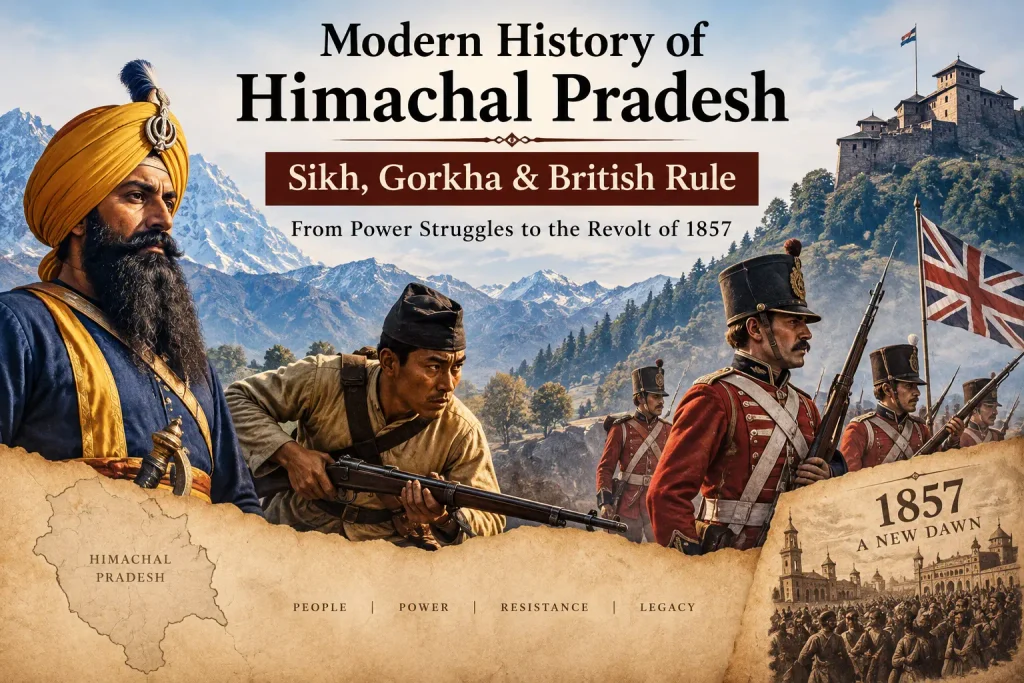
Explore the Modern History of Himachal Pradesh through the rise of Sikh influence, Gorkha expansion, the struggle for control of the hill states, British intervention, the Anglo-Gorkha War, Anglo-Sikh Wars and the Revolt of 1857. This comprehensive Modern Himachal History guide is designed for HPPSC, HPRCA, HP Patwari and other Himachal Pradesh competitive examinations.
Modern Himachal Pradesh History at a Glance
The modern history of Himachal Pradesh was shaped by changing political powers in the western Himalayas. The weakening of Mughal authority strengthened several hill rulers, while the growing influence of the Sikhs and the expansion of the Gorkhas transformed the political situation of the hill states.
During the late eighteenth and early nineteenth centuries, important figures such as Ghumand Chand, Sansar Chand and Maharaja Ranjit Singh played major roles in the political history of the region.
The expansion of the Gorkhas under Amar Singh Thapa brought them into conflict with the hill states, Sansar Chand and eventually the British East India Company.
The Anglo-Gorkha War of 1814–1815 marked a major turning point. After the Gorkhas were defeated, the British established their influence over many hill states through political arrangements and Sanads.
Later, the Anglo-Sikh Wars further changed the political map of the Himalayan hill states. The Revolt of 1857 also affected Himachal, with different rulers and groups taking different positions during the uprising.
Sikhs in the Hill States
The weakening of Mughal rule contributed to the strengthening of Hindu rulers in the hill states. At the same time, the Sikh community, which emerged in the Punjab plains, gradually became an important political and religious force in the Himalayan foothills and hill states.
Guru Nanak Dev Ji visited several areas associated with present-day Himachal Pradesh, including Kangra, Jwalamukhi, Kullu, Sirmaur, Chamba and Lahaul-Spiti, around 1514 AD.
Guru Arjan Dev and the Hill Rulers
The relationship between Sikh Gurus and the hill rulers became stronger during the period of Guru Arjan Dev.
- Guru Arjan Dev sought financial support for the completion of Harmandir Sahib at Amritsar.
- The rulers of Mandi, Kullu, Suket, Chamba and Haripur came forward to provide assistance.
Guru Hargobind and Kiratpur
Guru Hargobind established the town of Kiratpur in the Himalayan foothills near the Sutlej. The land was gifted by the Raja of Kahlur.
The relationship between the Sikh Guru and the hill rulers also had a political dimension. Guru Hargobind helped Raja Tara Chand of Kahlur in his conflict with the Nawab of Ropar in 1642.
Guru Tegh Bahadur and Anandpur
Guru Tegh Bahadur established the Sikh town of Anandpur in the region of Kahlur, corresponding to present-day Bilaspur.
Battle of Bhangani
The tenth Sikh Guru, Guru Gobind Singh, fought the Battle of Bhangani in 1686 AD.
The battle involved the forces of several hill rulers, including Raja Bhim Chand of Kahlur, Raja Harichand of Hindur (Nalagarh) and Fateh Shah of Garhwal.
The political relationships between the Sikh community and several Himalayan hill states continued to develop during the following period.
Sikh Misls in the Hill States
The Sikh Misls were groups or confederacies of Sikhs that became active in the political affairs of the Punjab and adjoining hill regions during the eighteenth century.
Jassa Singh Ramghia
Jassa Singh Ramghia exercised control over areas including Kangra, Nurpur and Chamba.
Kangra Fort and Jai Singh
- Jai Singh obtained control of Kangra Fort in 1783.
- He later surrendered the fort to Raja Sansar Chand in 1786.
Rise of Ranjit Singh
Maharaja Ranjit Singh gradually brought the Sikh Misls under his authority and established a powerful Sikh empire.
His influence extended over several hill states and territories, including:
- Chamba
- Nurpur
- Kotla
- Shahpur
- Mankot
- Jaswan
- Guler
- Kahlur
- Mandi
- Suket
- Kullu
A major development was the Treaty of Jwalamukhi in 1809 between Maharaja Ranjit Singh and Raja Sansar Chand.
Gorkhas in the Hill States
The expansion of the Gorkha state from Nepal and Kumaon created a major political force in the Central Himalayas. Under Prithvi Narayan Shah, the Gorkhas expanded their influence towards the western Himalayas.
By the late eighteenth and early nineteenth centuries, Gorkha expansion brought several Himalayan regions under their control.
Amar Singh Thapa
Amar Singh Thapa became one of the most important Gorkha commanders in the western Himalayan region.
- He conquered Garhwal, Sirmaur and Shimla by 1804.
- He was invited by rulers of Kahlur, Chamba and Mandi to help counter the expansion of Sansar Chand.
- After the Gorkha retreat from Kangra, Arki became an important Gorkha centre.
- Gorkha forces subsequently expanded towards Nalagarh and Rampur.
- The Gorkhas also established a major fort at Subathu.
Important Hill Chiefs
Ghumand Chand
Raja Ghumand Chand was an important Katoch ruler who played a major role in the expansion of Kangra power during the eighteenth century.
- Ahmad Shah Abdali appointed Ghumand Chand as Governor of Jalandhar in 1758–59 AD.
- His authority extended over hill regions between the Sutlej and Ravi.
- He expanded his influence across several hill states.
- His territory extended from areas around Chamba towards Sirmaur.
- He founded Sujanpur, which became an important centre of Katoch power.
Raja Sansar Chand
Raja Sansar Chand succeeded to the throne of Kangra in 1774 AD. He belonged to the Katoch dynasty and played a major role in the political history of the western Himalayan region.
Capture of Kangra Fort
Sansar Chand wanted to recover Nagarkot Fort, now known as Kangra Fort, which was under Mughal control through Nawab Saif Ali Khan.
- Sansar Chand sought the assistance of Jai Kanheya.
- The combined forces attacked the fort in 1781–82 AD.
- Kangra Fort was captured in 1783 AD.
- This ended Muslim rule over Kangra after a long period of Mughal control.
Expansion of Kangra
After capturing Kangra Fort, Sansar Chand expanded his influence over several hill states.
- Chamba
- Suket
- Mandi
- Bilaspur
- Guler
- Jaswan
- Datarpur
Patron of Kangra Art
Sansar Chand was also an important patron of art. Under his patronage, the famous Kangra School of Miniature Painting flourished.
Conflict with the Gorkhas
The expansion of Sansar Chand created opposition among several hill rulers. The rulers of Kahlur, Mandi and Chamba invited Amar Singh Thapa to counter his growing power.
Amar Singh Thapa attacked Kangra and defeated Sansar Chand at Mahal Morian, Nadaun and Sujanpur-Tira.
Treaty of Jwalamukhi, 1809
Facing pressure from the Gorkhas, Sansar Chand entered into the Treaty of Jwalamukhi in 1809 with Maharaja Ranjit Singh.
Ranjit Singh’s forces subsequently defeated the Gorkhas in 1809. Desa Singh Majithia was appointed Kiladar of Kangra Fort and Governor of the hill states.
After the death of Raja Sansar Chand in 1823 AD, his son Anirudh Chand succeeded him.
Maharaja Ranjit Singh and the Hill States
Maharaja Ranjit Singh emerged as the dominant Sikh ruler in the Punjab and extended Sikh authority into several Himalayan hill states.
- Ranjit Singh became chief of the Sukerchakia Misl.
- He established control over Lahore in 1798.
- He occupied Nurpur and Naushera.
- Kotla Fort came under his control in 1811.
- The state of Guler was annexed in 1813.
- Datarpur came under his authority in 1818.
- Kullu was among the last Kangra hill states to lose its independence to Sikh authority.
British Intervention in the Hill States
British intervention in the Himalayan hill states increased during the early nineteenth century as Gorkha expansion brought the Gorkhas into conflict with territories connected to the British East India Company.
In 1813, disputes arose over Gorkha expansion into villages in the plains of Sirhind. British political agent David Ochterlony declared that territories below the foothills would come under the authority of the East India Company.
The British also sought changes concerning areas such as Dehra and Kiarda Dun, which were associated with the Garhwal and Sirmaur ruling families.
British Trading Interests in the Hill States
British interest in the Himalayas was not limited to military and political considerations. Trade routes through the western Himalayas were also strategically important.
The Sutlej valley provided a natural route connecting the Punjab with the plateau of western Tibet.
Why Tibet Was Important
- Tibet was an important source of borax and musk.
- Himalayan passes were important for trade and movement.
- British policy was influenced by economic and strategic considerations.
- The hill regions and fertile Terai areas were also considered valuable for cultivation and recreation.
British Himalayan Policy of 1814
The British Himalayan policy of 1814 was shaped by three broad considerations:
- Local border problems
- Economic and strategic interests
- Control and use of hill and Terai regions
Anglo-Gorkha War, 1814–1815
Continuous territorial disputes and Gorkha expansion eventually led to war between the British and the Gorkhas.
The Anglo-Gorkha War began on 1 November 1814. Several hill chiefs supported the British because they wanted to end Gorkha control and recover their territories.
Battle of Nalapani
The Battle of Nalapani in 1814 was an important episode of the Anglo-Gorkha War.
- British forces captured Dehradun.
- Kiarda Dun came under British control.
- Kalanga Fort was captured.
- Ramgarh Fort was captured.
- Nalagarh came under British control.
- Bal Bhadra Thapa was associated with the Gorkha defence at Kalanga.
British Advance in Jubbal
In 1815, British forces under James Baillie Fraser moved towards Chopal and defeated the Gorkhas.
The British subsequently moved towards Rawingarh Fort, opposite Hatkoti in Jubbal, and captured it.
Two important local officials, Dangi Wazir and Primoo, joined the British forces.
Treaty of Sugauli, 1815
The Anglo-Gorkha War ended with the Treaty of Sugauli in 1815.
Under the treaty, the Gorkhas withdrew from the hill territories they had captured between the Kali and Sutlej rivers. These territories came under British authority.
Sanads to the Hill Chiefs
After the war, the British granted 20 Sanads to important hill rulers. These arrangements placed the hill states under British protection while imposing several obligations on the rulers.
- Hill chiefs had to allow free passage to British merchants.
- They were required to provide a specified number of begar labourers.
- They were required to construct twelve-foot-wide roads through their territories.
- The territory covered by these arrangements extended broadly from the Sutlej to the Teesta.
Sanads of Hill Chiefs under British Domination
The following hill rulers received Sanads under the British system of political control:
- Bilaspur — Raja Mahan Chand
- Baghal — Raja Jagat Singh
- Kuthar — Rana Bhup Singh
- Baghat — Rana Mohinder Singh
- Bhajji — Rana Ruder Pal
- Dhami — Goverdhan Singh
- Mahlog — Thakur Sansar Chand
- Beja — Thakur Man Chand
- Keonthal — Rana Sansar Sen
- Sirmaur — Raja Fateh Parkash
- Balsan — Thakur Yog Raj
- Nalagarh — Raja Ram Saran Singh
- Jubbal — Rana Puran Chand
- Sangri — Raja Bikramjit Singh
- Mangal — Rana Bahadur Singh
- Darkoti — Rana Surtes Singh
- Kunihar — Thakur Magan Deo
- Kumharsain — Rana Kehar Singh
- Bashahr — Raja Mohender Singh
- Tharoch — Thakur Jhobu
British Policy of Control
After defeating the Gorkhas, the British restored several hill states to their traditional rulers but retained political control over them.
The British justified their political involvement partly on the basis of protecting the hill chiefs from foreign invasion and helping them retain their traditional principalities.
At the same time, the British retained control over important military positions in the hill regions.
British policy also changed in relation to states where ruling families had become extinct or where succession and possession were disputed. Such territories could be taken under British authority.
Establishment of British Cantonments
The British established military cantonments at important strategic locations in the Himalayan region.
Subathu
After the Gorkha defeat in 1815, David Ochterlony established a cantonment at Subathu.
Subathu became the headquarters of the Nasiri Battalion, in which Gorkhas were recruited. This military tradition later became associated with the Gorkha Rifles.
Kasauli
Kasauli was established as a military station in 1842. An army regiment associated with the area was the 13th Light Infantry Regiment.
Dagshai
Dagshai developed as a cantonment consisting of a group of villages including Dabbi, Bughtiala, Dagshai, Chunawag and Jawag.
Balun
The areas around Dalhousie and Chamba were developed as a British cantonment and became known as Balun or Baloon.
Bakloh
Bakloh was established as a cantonment in 1866 for the 4th Gorkha Regiment.
Important Hill Regions under British Control
Keonthal
Keonthal was an important hill state. During the nineteenth century, disputes between the ruler and subjects led to British intervention.
- The state is traditionally associated with Raja Girisen.
- Around 1830, complaints were made against the ruler to the British Governor General.
- The ruler temporarily lost control of the state.
- He regained his position in 1840.
Sirmaur
During the Anglo-Gorkha conflict, the Gorkhas abandoned Nahan and established their defence at Jythak Fort.
The Gorkha commander was Ranjor Singh Thapa, son of Amar Singh Thapa.
- British forces reached Nahan on 19 December 1814.
- Jythak Fort was surrounded on 25 December 1814.
- Ranjor Singh Thapa was defeated.
- In 1815, Sirmaur was handed over to Fateh Prakash.
- As he was a minor, administration was carried out by his mother Guleri Rani under British supervision.
Bharoli
Bharoli was strategically important because control of the area provided command over the lower hills.
The British captured Subathu, Siwan and Bharoli to establish military bases.
Kotgarh and Rawin
The British acquired territories including Kotgarh and Rawin in the inner hills.
Kotgarh had passed through the control of different hill rulers before the Gorkhas captured its fort. In 1815, British forces captured Kotgarh along with the forts of Hattu, Silijan and Baji.
Jubbal
On 18 November 1815, the territory of Jubbal under the Sanad system was handed over to Rana Puran Singh and his heirs.
Due to administrative difficulties, the British later transferred administration to Dangi Wazir, who introduced several reforms.
In 1854, Karam Chand came to power. His harsh administration and use of begar brought him into conflict with the British Government, after which Jubbal came under greater British control.
Nurpur and Kangra
Raja Bir Singh of Nurpur and Raja Anirudh of Kangra sought refuge in British territory because of pressure from the Sikhs.
In 1815, hill chiefs assembled at Sialkot in a major gathering associated with the Sikh army. The rulers of Nurpur and Jaswan did not attend the assembly and were subsequently subjected to financial demands.
The conflict eventually resulted in further Sikh intervention in Nurpur.
Tharoch
After the death of Thakur Karam Singh in 1819, his heir Jhobu succeeded him.
In 1838, his nephew Raja Ranjit Singh claimed the throne and developed a strong political following.
In June 1843, his claim was recognized and a Sanad was granted to him. His authority was linked with the obligation of providing military service to the British Government.
Bilaspur
Kharak Chand succeeded to the throne of Bilaspur in 1824.
His actions created conflict with the Mians and other groups within the state.
In 1827, the British sent William Murray, a political agent, with troops to Bilaspur to address the conflict.
The British restored the position of certain Mians and warned the Raja to improve his administration. Before his death, Kharak Chand reached an understanding with the Mians and returned their jagirs.
Kotkhai
After the British conquest, Kotkhai was divided. Nine parganas were sold to the Raja of Patiala, while arrangements were made for the remaining revenue.
Development of Shimla
The British initially retained the Punar Pargana of Jubbal and later granted it to Rana Sansar Sen of Keonthal through a Sanad.
In 1830, the British developed the hill station of Shimla after acquiring twelve villages from the Rana and providing Rawin Pargana in exchange.
Baghat
After the death of Rana Mohinder Singh of Baghat in 1839, the British initially acquired the state.
George Russell Clerk opposed the acquisition and restored the authority of Vijay Singh, brother of Mohinder Singh.
Relations later deteriorated, particularly during the Nepal War, and the British seized the parganas of Baghat and sold them to the Maharaja of Patiala.
Anglo-Sikh Wars and Himachal Pradesh
After the death of Maharaja Ranjit Singh, conflicts between the Sikh Khalsa forces and the British increased. The Anglo-Sikh Wars had a major impact on the political status of the Himalayan hill states.
Several hill chiefs had grievances against Sikh rule because they had lost territories to Ranjit Singh. These political circumstances influenced their actions during the First Anglo-Sikh War.
First Anglo-Sikh War, 1845–1846
During the First Anglo-Sikh War, several hill rulers acted against Sikh positions and assisted the British.
Role of Hill Chiefs
- Shamsher Singh of Guler expelled Sikh forces from Haripur Fort.
- Bir Singh of Nurpur seized Nurpur Fort but died during the war.
- Raja Jaspal Pal of Kutlehr expelled Sikh forces from his state and captured its forts except Kamalgarh.
Treaty of Lahore, 9 March 1846
The First Anglo-Sikh War ended with the Treaty of Lahore on 9 March 1846.
Under the resulting political arrangements, hill territories between the Sutlej and Ravi came under direct British rule.
The areas included:
- Chamba
- Mandi
- Suket
- Kangra
- Nurpur
- Jaswan
- Datarpur
- Kullu
- Guler
- Lahaul and Spiti
Second Anglo-Sikh War, 1848–1849
After the First Anglo-Sikh War, the British retained many territories instead of restoring them to the hill chiefs. This created considerable resentment among the rulers of the Kangra group of states.
During the Second Anglo-Sikh War, several hill chiefs therefore chose to support the Sikhs rather than the British.
Revolt of the Hill Chiefs
The first revolt was associated with Ram Singh, Wazir of Nurpur, and Pramodh Chand of Kangra, along with the rulers of Jaswan and Datarpur.
The British Government sent forces under Mr Lawrence to suppress the revolt.
- The rebellious chiefs were defeated.
- Several leaders were exiled to Almora.
- Pramodh Chand died in Almora in 1851.
- Ram Singh was later defeated and sent to Singapore, where he died.
The Second Anglo-Sikh War brought an end to Sikh political rule in the hill areas and strengthened British authority in the region.
Revolt of 1857 and Himachal Pradesh
The Revolt of 1857, also known as the First Indian War of Independence, was caused by a combination of political, social, economic, religious and military grievances against British rule.
The uprising also affected the hill regions of Himachal Pradesh. Different rulers, soldiers and local groups responded to the revolt in different ways.
Revolt at Kasauli
The regiment stationed at Kasauli was among the first military groups in the region to participate in the revolt.
Raja Shamsher Singh of Bushahr
Raja Shamsher Singh of Bushahr stopped paying Khiraj to the British and maintained a policy of neutrality during the revolt.
Revolt in Kullu
Pratap Singh and Bir Singh of Kullu were accused of encouraging the revolt and were condemned to death.
The British destroyed the fort associated with Raja Pratap Singh, seized the state and stopped the pension of his widow, Queen Ranputi.
Revolt in Shimla
In Shimla, around 45 revolutionaries led an uprising against approximately 200 British sepoys.
The British eventually suppressed the revolt and Subedar Bhim Singh received capital punishment. He escaped to Rampur-Bushahr, where he later died by suicide after learning that the revolt had failed.
Hill Chiefs Who Supported the British in 1857
Not all hill rulers supported the revolt. Several chiefs cooperated with the British during the uprising.
- The Raja of Keonthal provided shelter to the British at Shimla and Junga and was subsequently granted the title of Raja.
- The rulers of Koti and Balsan supported the British.
- Bilaspur assisted the British at Boileauganj.
- Sirmaur supported the British at Bada Bazaar.
- Mian Jai Singh of Baghat cooperated with the British.
- Raja Bhajji of Dhami supported the British.
- Raja of Jubbal also cooperated with the British.
- Raja Shri Singh of Chamba sent soldiers under Mian Avtar Singh to Dalhousie to assist the British.
Important Modern Himachal Pradesh History Facts
- Guru Nanak Dev Ji visited several areas of the Himalayan region, including Kangra, Jwalamukhi, Kullu, Sirmaur, Chamba and Lahaul-Spiti.
- Guru Tegh Bahadur established Anandpur in the Kahlur region.
- Battle of Bhangani was fought in 1686 AD.
- Sansar Chand became ruler of Kangra in 1774 AD.
- Kangra Fort was captured in 1783 AD during the expansion of Sansar Chand’s power.
- The Kangra School of Miniature Painting flourished under the patronage of Sansar Chand.
- Treaty of Jwalamukhi was concluded between Sansar Chand and Ranjit Singh in 1809.
- The Anglo-Gorkha War began on 1 November 1814.
- The Treaty of Sugauli ended the Anglo-Gorkha War in 1815.
- The British granted 20 Sanads to hill chiefs after the Anglo-Gorkha War.
- Subathu became an important British military cantonment after the defeat of the Gorkhas.
- Bakloh was established as a cantonment for the 4th Gorkha Regiment in 1866.
- Shimla was developed as a British hill station after the acquisition of villages in 1830.
- The First Anglo-Sikh War took place in 1845–1846.
- The Treaty of Lahore was signed on 9 March 1846.
- The Second Anglo-Sikh War took place in 1848–1849.
- The Revolt of 1857 also affected several parts of Himachal Pradesh.
Modern Himachal Pradesh History Timeline
How to Study Modern History of Himachal Pradesh
Modern Himachal History becomes easier to remember when major events are studied as a sequence of changing political powers rather than as isolated facts.
Begin with the Sikh influence in the hill states and the rise of the Sikh Misls. Then study the expansion of Sansar Chand, the rise of the Gorkhas under Amar Singh Thapa, and the growing involvement of the British.
Next, focus on the Anglo-Gorkha War, Treaty of Sugauli and Sanads. These events explain the expansion of British political influence over the hill states.
Finally, revise the Anglo-Sikh Wars and Revolt of 1857 with special attention to the rulers, places, dates and political developments associated with Himachal Pradesh.
Frequently Asked Questions About Modern Himachal Pradesh History
What is included in the Modern History of Himachal Pradesh?
Modern Himachal Pradesh History includes Sikh influence in the hill states, Sikh Misls, Gorkha expansion, the rule and expansion of Sansar Chand, British intervention, the Anglo-Gorkha War, British control of hill states, Anglo-Sikh Wars and the Revolt of 1857.
Who was Sansar Chand?
Raja Sansar Chand was a Katoch ruler of Kangra who ascended the throne in 1774 AD. He expanded Kangra’s influence over several hill states and was an important patron of the Kangra School of Miniature Painting.
When was Kangra Fort captured by Sansar Chand?
Kangra Fort was captured in 1783 AD by forces associated with Raja Sansar Chand after his alliance with Jai Kanheya.
What was the Treaty of Jwalamukhi?
The Treaty of Jwalamukhi was concluded in 1809 between Raja Sansar Chand and Maharaja Ranjit Singh during the conflict involving the Gorkhas and the Kangra region.
Who was Amar Singh Thapa?
Amar Singh Thapa was an important Gorkha commander who expanded Gorkha control into several western Himalayan regions, including Garhwal, Sirmaur and Shimla.
When did the Anglo-Gorkha War begin?
The Anglo-Gorkha War began on 1 November 1814.
What was the Treaty of Sugauli?
The Treaty of Sugauli, concluded in 1815, ended the Anglo-Gorkha War and resulted in the withdrawal of Gorkha forces from the hill territories that came under British authority.
What were the Sanads of the hill chiefs?
After the Anglo-Gorkha War, the British granted Sanads to twenty hill chiefs. These arrangements recognized their rule while placing their states under British protection and imposing certain obligations.
When was the First Anglo-Sikh War fought?
The First Anglo-Sikh War was fought during 1845–1846 and ended with the Treaty of Lahore on 9 March 1846.
When was the Second Anglo-Sikh War fought?
The Second Anglo-Sikh War took place during 1848–1849.
Did Himachal Pradesh participate in the Revolt of 1857?
Yes. The Revolt of 1857 affected several areas of the hill region. Some groups and rulers participated in or supported the revolt, while several hill chiefs cooperated with the British.
Which hill rulers supported the British during the Revolt of 1857?
The material identifies rulers and chiefs associated with Keonthal, Koti, Balsan, Bilaspur, Sirmaur, Baghat, Dhami, Jubbal and Chamba among those who cooperated with the British.
Continue Your Himachal Pradesh History Preparation
Modern History completes the major historical sequence from ancient political communities and medieval hill kingdoms to the changing political landscape of the nineteenth century. Continue your preparation with dedicated MCQs and previous-year questions, or return to the complete HP History Hub.