
Himachal Pradesh GK • Medieval History
Medieval History of Himachal Pradesh
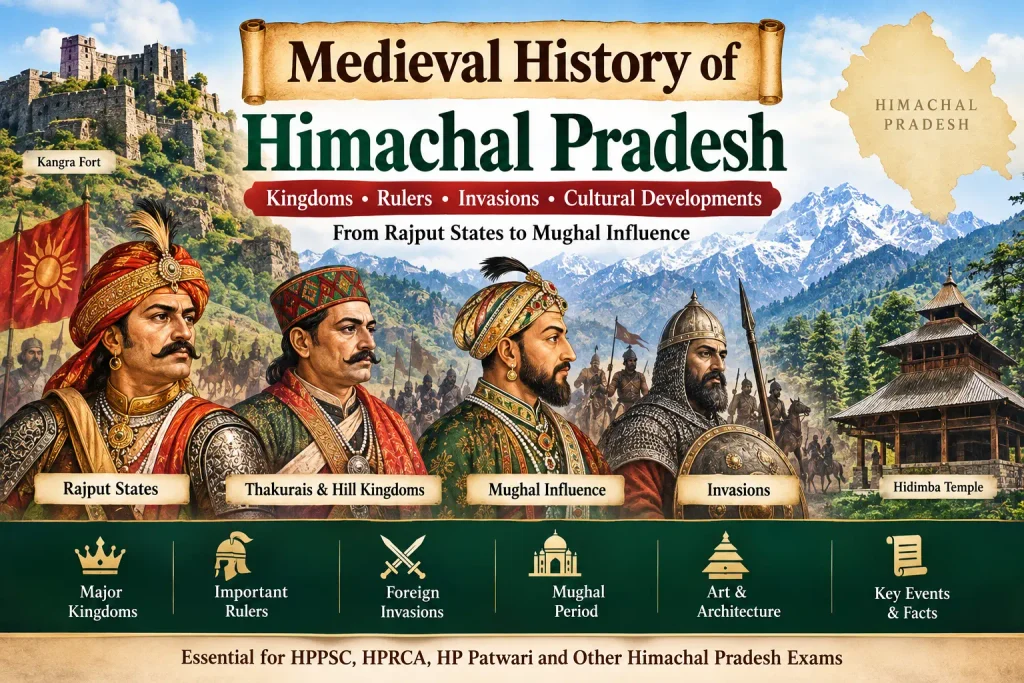
Explore the Medieval History of Himachal Pradesh through the rise of Rajput states, Thakurais, major hill kingdoms, Muslim invasions, Mughal relations and important rulers and events. This comprehensive Medieval Himachal History guide is designed for HPPSC, HPRCA, HP Patwari and other Himachal Pradesh competitive examinations.
Medieval Himachal Pradesh History at a Glance
The medieval history of Himachal Pradesh can broadly be divided into the Early Medieval Period and the Medieval Period. The early medieval period followed the death of Harshavardhan in 647 AD, when the political order changed and many local rulers regained greater independence.
The decline of larger political powers encouraged the development of numerous small hill states and principalities. The region witnessed the rise of Thakurais, Ranas, Thakurs and Rajput states, particularly across the hill areas between the Sutlej and Yamuna.
From the medieval period onwards, the Himalayan hills were affected by several major political powers. Important events include the invasions of Mahmud Ghaznavi, Muhammad Ghori, the Tughlaq rulers, Timur-i-lang, Sher Shah Suri and the Mughal rulers.
At the same time, important hill principalities such as Kangra, Chamba, Kullu, Mandi, Suket, Bilaspur, Sirmaur, Nurpur, Nalagarh and others developed their own political identities and histories.
For examination preparation, Medieval HP History is best studied by connecting rulers, dates, kingdoms, invasions, forts, temples and important political events.
Early Medieval Period of Himachal Pradesh
The Early Medieval Period began during a time of political change after the death of Harshavardhan in 647 AD. The rulers who had submitted to Harshavardhan were once again free to exercise greater independence.
The Ranas regained their Rahuns, while the Thakurs regained their Thakurais. This political fragmentation contributed to the emergence of several small states across the Himalayan region.
The area between the Sutlej in the north-west and the Yamuna in the south-east contained numerous small political units. These were organized into groups traditionally described as Twelve Thakurais and Eighteen Thakurais.
Twelve Thakurais of Himachal Pradesh
The Twelve Thakurais were small political territories in the hill region. They form an important part of the early medieval political history of Himachal Pradesh.
The Twelve Thakurais were:
- Keonthal
- Kunihar
- Mehlög
- Beja
- Baghat
- Bhajj
- Koti
- Bharoli
- Kuthar
- Dhami
- Mangal
- Baghal
Exam Point: The small hill territories were traditionally grouped into the Twelve Thakurais and Eighteen Thakurais.
Eighteen Thakurais of Himachal Pradesh
Another group of small political territories was traditionally known as the Eighteen Thakurais.
- Jubbal
- Sari
- Rawingarh
- Balsan
- Kumarsen
- Khaneti
- Delath
- Karangal
- Kotkhai-Kotgarh
- Ratesh
- Ghund
- Madhan
- Theog
- Darkoti
- Tharoch
- Dadi
- Sangri
- Dodra-Kwar
Quick Revision: The Twelve and Eighteen Thakurais represent the fragmented political landscape of the hill region during the early medieval period.
Gurjara Pratiharas and the Western Himalayan Region
After Harsha made Kannauj an important centre of power in northern India, a struggle developed among the Rashtrakutas, Palas and Pratiharas for political supremacy.
Kannauj became the seat of the Gurjara Pratiharas, whose influence extended northwards up to Kuluta (Kullu), although it did not extend over the Western Himalayas.
Lalitaditya and Yashovarman
The Rajatarangini provides information about a conflict between the ruler of Kashmir, Lalitaditya (724–760 AD), and Yashovarman (700–740 AD).
Yashovarman was defeated and after this conflict Trigarta, Brahmapura and other western hill regions came under Lalitaditya’s influence.
Shankaravarman and Trigarta
Another ruler of Kashmir, Shankaravarman (883–903 AD), later led an expedition towards Gujarat. He faced opposition from Prithvi Chandra of Trigarta.
Prithvi Chandra was defeated by Shankaravarman and Trigarta became part of Kashmir.
Rise of Rajput States in Himachal Pradesh
The decline of the Pratihara Empire during the latter half of the 10th century created conditions in which local landlords attempted to establish independent states.
This period witnessed the rise of Rajput states in Rajasthan and the Ganga-Yamuna Doab. Similar political developments also influenced the outer Himalayan ranges.
The period from the 8th to the 12th century saw the foundation of numerous states by Rajput migrants in the outer Himalayan ranges between the Ravi and Yamuna rivers.
Important examples include:
- Chamba
- Nurpur
- Kullu
- Suket
- Mandi
- Bilaspur
- Rampur
- Jubbal
- Keonthal
- Sirmaur
Some of these Rajput states were founded later, particularly during the 15th and 16th centuries.
Medieval Period of Himachal Pradesh
During the medieval period, the Himalayan hills experienced repeated political pressure and invasions from major powers operating in northern India.
The invasions of Mahmud Ghaznavi, Muhammad Ghori, the Tughlaq rulers, Timur-i-lang and Sher Shah Suri, followed later by Mughal expansion, affected the political history of several hill states.
Among the hill regions, Kangra and Nagarkot became particularly important because of their strategic location and the importance of the Kangra fort.
Mahmud Ghaznavi and Kangra
The year 1000 AD marks an important phase in the historical developments of northern India. While Rajput states were developing in the Himalayan region, northern India faced invasions by the Turkish ruler Mahmud Ghaznavi.
In 1009 AD, Mahmud Ghaznavi seized the treasury of Nagarkot and attacked the city of Kangra. He carried away a large amount of wealth and left forces behind to control Nagarkot.
The Nagarkot Fort remained under Ghaznavi’s control until 1043 AD.
In 1051–52 AD, Mahmud Ghaznavi’s son Abdul Rashid captured the Kangra fort, but the fort was later regained by the Katoch rulers around 1060 AD.
Exam Points:
- 1009 AD – Mahmud Ghaznavi attacked Nagarkot/Kangra.
- Nagarkot Fort became an important centre of conflict.
- Abdul Rashid captured the fort in 1051–52 AD.
- The Katoch rulers regained the fort around 1060 AD.
Muhammad Ghori and the Migration of Rajput Groups
During the latter part of the 12th century, invasions by Muhammad Ghori became an important factor in the political history of northern India.
His major invasions in India during the period from 1175 to 1192 AD affected the political situation of the northern plains.
As Muslim rulers established control over Delhi and expanded into the Indo-Gangetic plains, the Himalayan hills became a refuge for several groups.
Groups including the Chauhans, Chandels, Tomars, Panwars and Sens moved towards the Himalayan hills and established small principalities.
The Western Himalayas also served as a shelter for some Muslim rebel elements during the periods of the Slave Dynasty (1206–1290 AD) and Khilji Dynasty (1290–1320 AD).
Muhammad-bin-Tughlaq and Kangra
The Tughlaq period brought another important phase of conflict between the Delhi Sultanate and the hill states.
Muhammad-bin-Tughlaq personally led an expedition against Raja Prithvi Chand (1330–1345 AD) of Nagarkot, Kangra.
In 1337 AD, Muhammad-bin-Tughlaq captured the Nagarkot Fort of Kangra.
During this expedition, the Sultan showed religious tolerance and spared the Jwalamukhi Temple.
Later, when Raja Rup Chand came to the throne in 1360 AD, he attempted to recover territory and challenged Muslim authority in the region.
Key Date: Muhammad-bin-Tughlaq captured Nagarkot Fort in 1337 AD.
Firoz Shah Tughlaq and Nagarkot
Continued resistance by Raja Rup Chand eventually provoked Firoz Shah Tughlaq, who led an expedition against Nagarkot in 1361 AD.
Firoz Shah moved towards the Jwalamukhi Temple and destroyed the temple.
After a siege lasting approximately six months, Raja Rup Chand surrendered to Firoz Shah Tughlaq and accepted his supremacy.
The Sultan also took religious books from Jwalamukhi and had them translated into Persian. The resulting work is identified as Dalail-i-Firozshahi.
Exam Points:
- 1361 AD – Firoz Shah Tughlaq invaded Nagarkot.
- The conflict involved Raja Rup Chand.
- The siege of Nagarkot lasted about six months.
- Dalail-i-Firozshahi is associated with the translated works from Jwalamukhi.
Timur-i-lang and the Invasion of the Hills
In 1398 AD, the raids of Timur-i-lang created another major disturbance in northern India.
Timur invaded Delhi, Meerut and Haridwar and subsequently entered the Shivalik hills.
He invaded the Kiard Dun Valley of Sirmaur and, while returning along the foothills of Sirmaur, reached the frontier of Hindur, identified with the Nalagarh region.
Alam Chand (1356–1406 AD) was the chief of Hindur at that time.
Timur also attempted to capture Nagarkot, but could not succeed. The Kangra ruler Megh Chand (1390–1405 AD) strongly resisted him.
Timur captured eight forts of the hill state, including Pathankot and Nurpur, which was earlier known as Dhameri.
Sher Shah Suri and Kangra
Sher Shah Suri also played a role in the political history of the Kangra region.
Sher Shah Suri captured the Kangra Fort in 1540 AD through his commander Khan Jahan.
In 1556 AD, his army again entered the Himalayan hills under the leadership of Khawas Khan and Sikander Shah Suri.
Quick Revision: Sher Shah Suri – 1540 AD – Kangra Fort.
Mughal Dynasty and Himachal Pradesh
During the 16th century, Mughal power increasingly affected the Himalayan hill states. Kangra became an important focus of Mughal expansion because of its strategic and political importance.
The Mughal period is particularly associated with the reigns of Akbar, Jahangir, Shah Jahan and Aurangzeb.
Akbar and Kangra
During the reign of Akbar, Mughal relations with the Kangra rulers became increasingly important.
In 1562 AD, an alliance was formed between Akbar and Raja Dharam Chandra. Akbar granted Dharam Chand the title of Maharaja.
The alliance was ended after approximately ten years.
In 1573 AD, Akbar appointed his finance minister Raja Todar Mal to acquire the Kangra fort.
66 villages of Kangra, Rihlu, Cheri, Gharoh and Patyhar from Chamba, along with other territories of hill states, were annexed by Akbar.
The Kangra ruler Jai Chand was imprisoned by the Mughal rulers.
The Akbarnama describes Akbar’s visit to the Jwalamukhi Temple and records the presentation of a gold roof to the temple.
Important Names: Akbar • Raja Dharam Chandra • Raja Todar Mal • Jai Chand • Jwalamukhi • Kangra Fort
Jahangir and the Capture of Kangra Fort
After becoming emperor in 1605 AD, Jahangir planned to capture the Nagarkot Fort of Kangra.
In March 1615, Jahangir appointed Murtaza Khan, Governor of Punjab, and Suraj Mal, son of Raja Basu of Dhameri-Nurpur, to undertake the campaign against Kangra.
Suraj Mal did not accept the arrangement and revolted against Jahangir. The emperor subsequently sent Raja Bikramajit and Abdul Aziz to suppress the revolt and continue the campaign against Kangra.
The rebellion continued for about one year. Suraj Mal eventually fled to Chamba, where he died. His property was subsequently taken by the Mughals.
Jahangir finally acquired possession of the Nagarkot Fort in 1620 AD.
This was a major turning point because the fort passed from the Katoch rulers to the Mughals for the first time and remained under Mughal control for the next 163 years.
Jahangir also built a mosque in the Nagarkot Fort in 1621 AD.
Most Important Date: 1620 AD – Jahangir acquired possession of Nagarkot Fort.
Shah Jahan and the Katoch Struggle
After ascending the Mughal throne in 1627 AD, Shah Jahan continued Mughal control over Kangra.
The Katoch royal family was given a small jagir at Rajgiri, but the family continued its efforts to regain control of the Kangra fort.
Raja Hari Chand adopted guerrilla warfare against Mughal authority. He was captured and executed by Mughal forces in 1627 AD, according to the historical account used for this page.
Aurangzeb and the Hill States
Aurangzeb became the Mughal ruler in 1658 AD.
In 1678 AD, Aurangzeb issued an order concerning the demolition of temples in Chamba.
Raja Chatar Singh refused to obey the order and directed that the tops of the temples be covered with gold as a mark of opposition to Mughal authority.
Raja Chander Bhan built a fort near Dharamshala at Nirwanah and continued resistance against Mughal rule in Kangra.
Aurangzeb appointed Mughal Nawabs to administer Kangra Fort.
Fall of Mughal Power and Rebellion of Hill Rulers
The death of Aurangzeb in 1707 AD was followed by a weakening of Mughal authority. Political instability in northern India created opportunities for regional powers and hill rulers to assert greater independence.
Nadir Shah, ruler of Persia, invaded India in 1738–1739 AD and captured Delhi and Punjab.
From 1747 AD, Ahmad Shah Abdali and his successors also launched invasions into India, further weakening Mughal authority.
In 1758–59 AD, Ahmad Shah Abdali appointed Raja Ghumand Chand (1751–1774) as Governor of Jalandhar and the hills between the Sutlej and Ravi rivers.
Mughal authority still existed in parts of Himachal, as Kangra Fort remained under Saif Ali Khan, one of the last Mughal officers associated with the fort.
Sansar Chand and the End of Muslim Rule in the Hill States
Sansar Chand, grandson of Raja Ghumand Chand, became ruler of Kangra in 1775 AD.
One of his major objectives was to regain the Kangra Fort.
To achieve this, Sansar Chand sought the assistance of Jai Singh Kanheya, a Sikh chieftain. Their combined forces attacked the Kangra fort during 1781–82 AD.
In 1783 AD, the fort came into the hands of the Sikhs. This event marked the end of Muslim rule in the hill states.
Important Sequence:
- 1775 AD – Sansar Chand became ruler of Kangra.
- 1781–82 AD – Combined forces attacked Kangra Fort.
- 1783 AD – Kangra Fort passed into Sikh hands.
Major Medieval Principalities of Himachal Pradesh
Medieval Himachal Pradesh was characterized by numerous hill principalities. These states often maintained their own rulers, territories and political traditions while competing with neighbouring states and larger powers.
The following principalities are particularly important for Himachal Pradesh History and competitive examinations.
Bilaspur (Kahlur)
The state of Bilaspur, also known as Kahlur, was founded by Bir Chand in 617 AD.
Bir Chand was the elder son of Harihar Chand, who came from Chanderi in Bundelkhand.
The state was located in the lower Sutlej valley. Before Bir Chand’s rule, the region was controlled by local chiefs known as Ranas and Thakurs.
Bir Chand declared Naina Devi as his capital and built a temple dedicated to Naina Devi. He also constructed a fort called Kot Kahlur.
Key Facts:
- State: Bilaspur / Kahlur
- Founder: Bir Chand
- Date: 617 AD
- Region: Lower Sutlej Valley
- Capital: Naina Devi
- Fort: Kot Kahlur
Kangra
Kangra was one of the most important political and strategic regions of the Western Himalayas.
The state was established in the ancient period by Katoch Kshatriya Rajputs of the Chandervanshi lineage.
Kangra was associated with ancient Trigarta and was known as Nagarkot. The region and its fort were known by several names during different periods, including Bhimkot, Susharmapura, Katoch and Nagarkot.
Kangra was also associated with the names Trigarta and Jalandharyan.
Historical references to Kangra occur in sources including Rajatarangini, Padma Purana, the travel account of Hiuen Tsang, references attributed to Ptolemy and Alexander Cunningham’s Ancient Geography of India.
Smaller States Emerging from Kangra
Following Muslim invasions and political changes, several smaller principalities became independent in the Kangra region.
- Jaswan
- Guler
- Siba
- Datarpur
Jaswan
Raja Purab Chand founded Jaswan as an independent state in 1170 AD.
Guler
Hari Chand founded Guler in 1405 AD. He built the town and fort of Haripur and established the Guler state.
Siba
Sibran Chand, the younger brother of Guler chief Hari Chand, founded Siba in the middle of the 15th century.
Datarpur
Datar Chand founded Datarpur in 1550 AD. He was a descendant of the Siba family.
Kutlehr
Raja Jaspal established Kutlehr on the border of Kangra and Hoshiarpur during the 10th or 11th century.
He established his capital at Kot Kutlehr. Jaspal is described as a Brahmin who, after gaining political power, came to be recognized as a Rajput.
Traditions concerning his origin connect him with Sambhal near Moradabad, while family records identify his descent from a Raja of Poona.
His descendants are associated with the foundation of the small Shimla hill states of Bhajji and Koti.
Nurpur
The state of Nurpur was founded by the Tomar Rajput Jhetpal of Delhi, who settled at Pathankot in 1095 AD.
Because of this association, the chiefs of Nurpur are known as the Pathania clan.
Nurpur included the present tehsil of Kangra along with areas of Shahpur and Kandi.
Its capital was Pathankot, identified with the ancient name Pratishthana.
The state was conquered by the Sikhs in 1809 and subsequently became part of the Lahore Kingdom.
Exam Point: Nurpur – Jhetpal – Tomar Rajput – 1095 AD – Pathania clan.
Nalagarh (Hindur)
Nalagarh, also known as Hindur, developed as another important hill state.
Ajai Chand, son of Kahn Chand of Bilaspur, invaded the territory of Handu, described as the Brahmin Thakur of Hindur.
Ajai Chand defeated Handu and established the Nalagarh state around 1100 AD.
Sirmaur
Reliable information about the early history of Sirmaur is limited.
It is traditionally believed that the rulers belonged to the Rathore clan, and the capital was Sirmaur or Sirmauri Tal.
During the 12th century, a major flood in the Giri River destroyed the capital of the ruler Raja Ugra Chand and several of his principal officers.
The throne subsequently remained vacant. According to the historical tradition, Hoshang Rai, the minister of Sirmaur, invited Salvahan-II, who belonged to the Jaisalmer clan, to succeed to the throne.
Salvahan-II sent his son Sobha to Sirmaur. In 1195 AD, Sobha became ruler of Sirmaur and assumed the title Shubhansh Prakash.
Key Facts: Giri River flood • Raja Ugra Chand • Hoshang Rai • Salvahan-II • Sobha • 1195 AD
Baghal / Bhanghal
The state of Baghal/Bhanghal was founded around 1200 AD by a Brahmin who, after gaining political power, became known as a Rajput.
His descendants ruled the state for approximately twenty generations.
After the murder of Prithvi Pal, the power of the state declined.
Its capital was at Bir in Bir Bangahal. Raja Rajendra Pal was the last ruler of Bhanghal.
Suket
The state of Suket was founded by Bir Sen, who was the grandson of the Bengal ruler Lakshman Sen.
When Bakhtiyar Khilji attacked Bengal in 1198–99 AD, Lakshman Sen escaped from his capital, Nadia. He died in 1210 AD.
Bir Sen crossed the Sutlej River and reached Juri. He then conquered neighbouring small principalities and established the state of Suket.
The state of Suket was founded in 1241 AD, with Pangna as its capital.
Exam Point: Suket – Bir Sen – Pangna – 1241 AD.
Mandi
Mandi is situated on the banks of the Beas River and was an important market centre.
During the rule of Sahu Sen of Suket around 1330 AD, his younger brother Bahu Sen quarrelled with him and went to Manglore in Kullu.
Eleven generations of his family lived there until Karan Chand Sen, the head of the family, was killed in a war with a Kullu ruler.
Karan Chand Sen’s queen was the daughter of the Rana, the chief of Seokot in Mandi. As the Rana had no male heir, he declared his daughter’s son, Ban Sen, chief of Seokot.
Ban Sen built a new residence at Bhinuli in Mandi. Mandi therefore developed as an offshoot of Suket and eventually became a separate state.
The 19th descendant of Bahu Sen, Ajbar Sen, built the town of Mandi in 1527 AD.
Important Date: 1527 AD – Ajbar Sen built the town of Mandi.
Kullu
The history of Kullu, known in ancient sources as Kuluta, extends back to the ancient period.
Vihangmani Pal founded the Pal dynasty in Kullu during the 2nd century AD.
The Pal dynasty continued until approximately 1450 AD. After this, the region came under the influence of Ranas and Thakurs.
The Singh dynasty was established in Kullu around 1510 AD by Sidh Singh.
The Singh dynasty continued until the period of the Anglo-Sikh War.
The valleys of Lahaul and Spiti were also part of Kullu.
Chamba
The Chamba region has a long historical tradition extending into the ancient period.
Sangha Kols and Audambars inhabited the Chamba region during the 2nd century BC.
A prince from Kannauj named Maru is traditionally believed to have established Chamba with its capital at Brahmapura in 550 AD.
A descendant of Maru, Aditya Varman, founded the Varman dynasty in Chamba in 620 AD.
From 1641, during the reign of Prithvi Singh, the title Varman was dropped and the rulers accepted Mughal authority and paid tribute to the Mughals.
In 1770 AD, Chamba came under Sikh influence.
Key Facts:
- 550 AD – Maru traditionally associated with the establishment of Chamba.
- Brahmapura – capital mentioned in the historical tradition.
- 620 AD – Aditya Varman and the Varman dynasty.
- Prithvi Singh – associated with the change in title and Mughal relations from 1641.
- 1770 AD – Chamba came under Sikh influence.
Important Medieval History Facts to Remember
Medieval Himachal Pradesh history contains many names, dates and political transitions. The following points are especially useful for quick revision.
- 647 AD: Death of Harshavardhan and the beginning of a period of political fragmentation.
- The early medieval hill region included the Twelve and Eighteen Thakurais.
- 1009 AD: Mahmud Ghaznavi attacked Nagarkot/Kangra.
- 1337 AD: Muhammad-bin-Tughlaq captured Nagarkot Fort.
- 1361 AD: Firoz Shah Tughlaq led an expedition against Nagarkot.
- 1398 AD: Timur-i-lang invaded parts of the Shivalik and Sirmaur region.
- 1540 AD: Sher Shah Suri is associated with the capture of Kangra Fort.
- 1620 AD: Jahangir acquired possession of Nagarkot Fort.
- 1621 AD: Jahangir built a mosque in Nagarkot Fort.
- 1678 AD: Aurangzeb’s temple-related order concerning Chamba is recorded in the historical tradition.
- 1707 AD: Death of Aurangzeb and weakening of Mughal authority.
- 1775 AD: Sansar Chand became ruler of Kangra.
- 1783 AD: Kangra Fort came into Sikh hands.
- Important medieval principalities included Bilaspur, Kangra, Nurpur, Nalagarh, Sirmaur, Baghal, Suket, Mandi, Kullu and Chamba.
Medieval Himachal Pradesh History Timeline
Important Historical Sources for Medieval Himachal Pradesh
Medieval Himachal Pradesh history is reconstructed using chronicles, travel accounts and historical works. Important historians and works associated with the period include:
- Kalhana: Rajatarangini — associated with the period 1148–1150 AD.
- Al-Biruni (Abu Rihan): Taqiq-mal-l-Hind — associated with 1017–1030 AD.
- Al-Utbi: Tarikh-i-Yamini — associated with 1009 AD.
- Ziauddin Barani: Tarikh-i-Firozshahi and Tarikh-i-Firoz Farishta — associated with 1285–1357 AD.
Exam Tip: Questions may ask you to match a historian or traveller with his historical work. These source-work associations are therefore useful for revision.
How to Study Medieval History of Himachal Pradesh
Medieval HP History contains a large number of rulers, kingdoms, invasions and dates. Instead of memorizing everything at once, divide the subject into clear groups.
First understand the Early Medieval Period and the development of the Thakurais and Rajput states. Then study the major invasions and political developments involving Mahmud Ghaznavi, Muhammad-bin-Tughlaq, Firoz Shah Tughlaq, Timur-i-lang and Sher Shah Suri.
Next, focus on the Mughal period and remember the sequence of Akbar → Jahangir → Shah Jahan → Aurangzeb, particularly their relationship with Kangra and the hill states.
Finally, study the individual principalities such as Kangra, Chamba, Kullu, Mandi, Suket, Bilaspur, Sirmaur, Nurpur and Nalagarh.
Once the learning section is complete, use dedicated MCQs and previous-year questions to test your preparation.
Frequently Asked Questions About Medieval Himachal Pradesh History
What are the main periods of Medieval Himachal Pradesh History?
Medieval Himachal Pradesh History can broadly be divided into the Early Medieval Period and the Medieval Period.
What were the Twelve Thakurais?
The Twelve Thakurais were a group of small political territories in the hill region. They included Keonthal, Kunihar, Mehlög, Beja, Baghat, Bhajj, Koti, Bharoli, Kuthar, Dhami, Mangal and Baghal.
What were the Eighteen Thakurais?
The Eighteen Thakurais included Jubbal, Sari, Rawingarh, Balsan, Kumarsen, Khaneti, Delath, Karangal, Kotkhai-Kotgarh, Ratesh, Ghund, Madhan, Theog, Darkoti, Tharoch, Dadi, Sangri and Dodra-Kwar.
When did Mahmud Ghaznavi attack Nagarkot?
Mahmud Ghaznavi attacked and seized the treasury of Nagarkot in 1009 AD.
When did Muhammad-bin-Tughlaq capture Kangra Fort?
Muhammad-bin-Tughlaq captured the Nagarkot Fort of Kangra in 1337 AD.
When did Jahangir capture Kangra Fort?
Jahangir acquired possession of the Nagarkot Fort in 1620 AD. The fort subsequently remained under Mughal control for the next 163 years.
Who was Sansar Chand?
Sansar Chand, grandson of Raja Ghumand Chand, became ruler of Kangra in 1775 AD. He sought to regain Kangra Fort and later joined forces with Sikh chieftain Jai Singh Kanheya.
Which were the important medieval principalities of Himachal Pradesh?
Important principalities included Bilaspur, Kangra, Nurpur, Nalagarh, Sirmaur, Baghal, Suket, Mandi, Kullu and Chamba.
Why is Kangra important in Medieval Himachal History?
Kangra was an important political and strategic region in the Western Himalayas. Its Nagarkot/Kangra Fort was involved in conflicts involving Mahmud Ghaznavi, the Tughlaq rulers, Timur-i-lang, Sher Shah Suri, the Mughals, Katoch rulers and later Sikh forces.
Continue Your Himachal Pradesh History Preparation
Medieval History explains the development of hill kingdoms, Rajput principalities, major invasions and the changing political influence of the Delhi Sultanate, Mughals and Sikh powers. Continue with Modern Himachal History or return to the complete HP History Hub.