
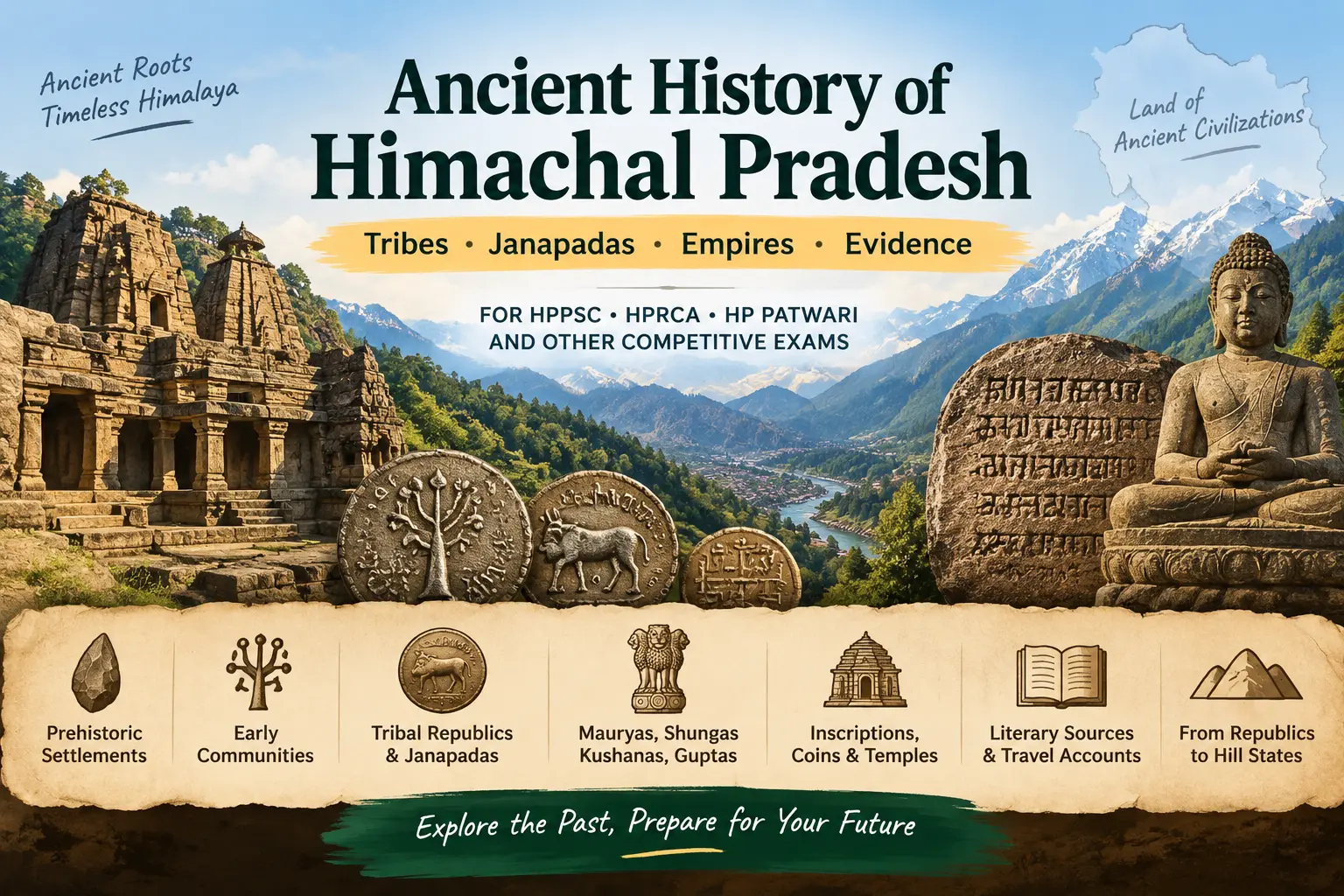
Himachal Pradesh GK • Ancient History
Ancient History of Himachal Pradesh
Explore the Ancient History of Himachal Pradesh through prehistoric evidence, early communities, tribal republics, Janapadas, inscriptions, coins, literary sources and major dynasties. This comprehensive Ancient Himachal History guide is designed for HPPSC, HPRCA, HP Patwari and other Himachal Pradesh competitive examinations.
Ancient Himachal Pradesh History at a Glance
The ancient history of the region that forms present-day Himachal Pradesh was not the history of one unified kingdom. Different parts of the western Himalayas were associated with different tribes, Janapadas, republics, kingdoms and larger political powers at different times.
The history of ancient Himachal Pradesh is reconstructed from several forms of evidence. Archaeological discoveries, inscriptions, temples, coins, literary and religious texts, travel accounts and genealogical traditions all contribute to our understanding of the region’s past.
Important ancient political communities associated with the region include the Audumbaras, Trigartas, Kulutas and Kulindas or Kunindas. The region also interacted with wider political powers including the Mauryas, Shungas, Kushanas, Guptas and Huns.
For students preparing Ancient HP GK, the most important approach is to connect historical facts with their evidence. Knowing not only what happened but also which source tells us about it makes ancient history easier to understand and revise.
Evidence for Ancient Himachal Pradesh History
Ancient Himachal Pradesh does not have one continuous historical record. Historians therefore use different types of evidence to reconstruct its ancient past. The most useful categories are archaeological evidence, inscriptions, coins and literary or travel accounts.
Archaeological Evidence
Archaeological remains provide important evidence about early human activity and the material culture of the Himalayan region. The sources used for Himachal Pradesh history mention archaeological discoveries from areas including the foothills of Nalagarh, Suketi and Kalpa, as well as Guler, Dehra and Dhaliyera in Kangra, the Banganga-Beas valley, the Sirsa-Sutlej valley, Bilaspur and parts of Sirmaur.
Stone tools and other material remains are particularly important for the study of prehistoric Himachal Pradesh. The supplied historical material records tools such as axes, chisels, picks, axe-hammers and ring stones from Ror near Kangra and associates them with very early human activity. The exact dating and interpretation of some such prehistoric evidence should be treated carefully when used for examination preparation.
Inscriptions as Historical Evidence
Inscriptions provide another important source for Himachal Pradesh history. The historical material records inscriptions and copper-plate grants from different parts of the state and mentions examples from Pathiyar and Khaniyara in Kangra, Hatkoti in Shimla, Salanu near Mandi and Sarahan.
The sources also mention inscriptions written in scripts including Sharda, Tankri, Kharosthi and Brahmi. A copper-plate record from Nirmand in Kullu, attributed in the supplied material to Maharaja Samudrasena and dated to the 7th century AD, provides evidence for the historical period that followed the ancient era.
These examples demonstrate why inscriptions are valuable: they can preserve names, titles, political relationships, religious information and details about particular historical periods.
Coins and Numismatic Evidence
Coins are among the most valuable sources for understanding ancient political communities. They can provide information about rulers, political authority, economic activity, symbols and cultural connections.
The historical material records early copper coins associated with the Trigarta region and mentions Indo-Greek coins and worn silver punch-marked coins found in areas including Kangra and Arki. A large hoard of silver Indo-Greek coins was reportedly discovered near Lachori in Chamba in 1970.
Coins associated with the Kunindas and Audumbaras were found at Jwalamukhi in Kangra, while Audumbara coins were also found at Tappa Mewa in Hamirpur. These discoveries make numismatic evidence especially important for the study of ancient Himachal Pradesh GK.
Temples and Antiquities
Ancient and early historical monuments also contribute to the reconstruction of Himachal’s past. The rock-cut temples at Masrur in Kangra are an important archaeological complex. The supplied material describes a group of fifteen rock-cut temples at Masrur and attributes them to the 8th century AD.
Other examples mentioned in the historical material include a wooden temple at Makraha in Kullu and an image of Lord Vishnu found at Fatehpur in Kangra. These monuments and antiquities provide evidence for the religious, architectural and artistic traditions of the Himalayan region.
Literary Sources of Ancient Himachal Pradesh History
Literary sources complement archaeological evidence by preserving references to ancient communities, geographical regions and political formations. Important sources include Vedic literature, the epics, Puranas, classical works, historical chronicles and travel accounts.
Vedic and Religious Literature
The four Vedas, along with texts such as the Aitareya Brahmana and Taittiriya Samhita, are mentioned in the supplied material as sources containing references relevant to tribes living around the Himalayan foothills.
The Mahabharata, Ramayana, Puranas and Brihat Samhita also contain references to Himalayan peoples and regions. The Vishnu Purana, for example, refers to the people of Kulu as Kuluta, while the supplied material connects references in the Ramayana, Mahabharata and Brihat Samhita with Kuluta and Trigarta.
These references are important for reconstructing ancient geographical names and political communities, but literary traditions should be read alongside archaeological and numismatic evidence.
Panini and Ancient Political Communities
Panini is an important literary source for the study of ancient north-western India. The supplied material identifies his references to communities such as the Audumbaras and Trigartas, making his work relevant to the study of ancient Himachal Pradesh and its neighbouring regions.
Rajatarangini
Kalhana’s Rajatarangini, a historical chronicle of Kashmir, provides information relevant to the political history of the western Himalayan region. The supplied material specifically connects it with the influence of Lalitaditya over the Kangra valley and western hills.
Travel Accounts
The Chinese traveller Hiuen-Tsang visited India during the reign of Harsha in the 7th century AD. His travel account, Si-Yu-Ki, contains observations about places including Jalandhara and Kuluta.
The supplied material also identifies European travellers such as J. B. Fraser, Forster, Vigne, Harcourt and Cunningham as later sources for the history and geography of the Himalayan hill states.
Persian Sources and Genealogies
Persian chronicles are particularly useful for later historical periods, including accounts of Muslim expeditions against Kangra. The supplied material mentions works such as Tarikh-i-Yamini, Habib-us-Siyar and Tarikh-i-Ferishta.
Vamshavalis, or genealogical records, preserve traditions concerning royal families of Kangra, Chamba, Mandi, Kullu and Nurpur. These records are useful when studied alongside archaeological and literary evidence.
Prehistoric Himachal Pradesh
The prehistoric period forms the earliest stage of the history of Himachal Pradesh. Archaeological discoveries help researchers understand early human activity, settlement and material culture in the Himalayan foothills and valleys.
Early Human Communities
The historical material supplied for this page identifies the Shiwalik foothills and other Himalayan valleys as areas associated with early communities. It discusses the Kols or Mundas among the earliest communities traditionally associated with the hills.
Traditional accounts also refer to communities such as Kolis, Halis, Dums and Chanals in the western Himalayan region and Chamangs and Damags in Kinnaur and Lahaul-Spiti.
Evidence and Tradition
Prehistoric history must be approached differently from later political history. Archaeological tools and settlement evidence can provide physical evidence of human activity, while later literary traditions provide information about communities and peoples. These two forms of evidence should not automatically be treated as equivalent.
Early Peoples and Vedic References
Kols and Mundas
The Kols, also referred to as Mundas in the supplied historical material, are traditionally associated with early population groups of the Himalayan foothills. Their place in Ancient Himachal History is discussed as part of the wider study of early communities and migration.
Khashas
The Khashas are another important community in traditions concerning the western Himalayas. The supplied material describes their settlement in Himalayan valleys and their organization into families and villages.
Accounts concerning the Khashas should be read as historical traditions and interpreted carefully rather than reduced to simplistic racial or ethnic classifications.
Vedic Communities
Vedic and post-Vedic literature contains references to communities and peoples associated with the Himalayan region. The supplied material mentions terms such as Dasas, Dasyus and Nishadas in Vedic literature and Kinnaras, Nagas and Yakshas in later traditions.
It also preserves traditions concerning sages associated with different Himalayan locations, including Jamdagni near Renuka Lake, Vashishtha near Manikaran and Parashurama traditions at Nirmand.
Tribal Republics and Janapadas of Ancient Himachal Pradesh
The transition from early tribal communities to organized political formations is one of the most important themes in Ancient Himachal Pradesh History. Ancient literary traditions describe different types of Janapadas, including monarchial and republican or Sangha formations.
Among the important ancient political communities associated with the Himalayan region were the Audumbaras, Trigartas, Kulutas and Kulindas or Kunindas.
Audumbaras
The Audumbaras, also called Udumbaras or Odumbaras, were an important ancient political community associated with the north-western Himalayan region. The supplied material connects their territory with areas along important routes linking the Himalayan region with Taxila, the Gangetic valley and Kashmir.
Literary references, particularly the reference attributed to Panini, are used to establish the antiquity of the community. Numismatic evidence is especially important because both copper and silver coins associated with the Audumbaras have been reported.
Audumbara coins found at Jwalamukhi in Kangra and Tappa Mewa in Hamirpur provide concrete archaeological evidence for the study of this ancient community. Their coinage also makes the Audumbaras an important topic in Ancient HP GK.
Trigarta
Trigarta is one of the most important ancient political regions associated with the western Himalayan area. The supplied material identifies references to Trigarta in Panini, the Mahabharata, Brihat Samhita and the Puranas.
It associates Trigarta broadly with the territory drained by the Ravi, Beas and Sutlej rivers and records a tradition describing Trigarta as an alliance of six states.
Numismatic evidence also contributes to the study of Trigarta. The supplied material mentions square-shaped coins as evidence associated with an independent republican political formation in the 2nd century BC.
A separate traditional account in the supplied material identifies Susharman Chand of the Katoch dynasty as the founder of Trigarta and associates him with the Mahabharata tradition. This should be understood as a traditional historical account rather than presented as an archaeologically established date.
Kuluta
Kuluta was an ancient Himalayan political region associated with the upper Beas valley and the area now known as the Kullu valley. References to Kuluta occur in the Ramayana, Mahabharata, Puranic literature and Brihat Samhita.
The supplied material also identifies a chapter called Kulutapitha Mahatmya in the Bhrampuran and mentions a copper coin bearing the name of the Kuluta king Virayasa. Naggar is identified in the source as the capital of the Kulutas.
Kulindas or Kunindas
The Kulindas, commonly referred to as Kunindas, were another important ancient political community associated with the Himalayan region. References to the Kulindas occur in the Mahabharata, Vishnu Purana, Vayu Purana and Markandeya Purana.
The supplied material places the Kulinda territory broadly between the Beas, Sutlej, Ganga and Yamuna rivers and notes that the community was also mentioned by Ptolemy in his Geographika.
Numismatic evidence is particularly important for Kuninda history. Coins associated with King Amoghabhuti are mentioned in the source, with Brahmi and Kharosthi appearing in connection with different forms of coinage.
The source also describes the Kulindas as having a republican form of administration and explains that their copper and silver coinage served different circulation purposes.
Major Empires and Dynasties Connected with Ancient Himachal
The ancient history of Himachal Pradesh was influenced by both local political communities and larger empires. The Mauryas, Shungas, Kushanas and Guptas form an important part of the broader political history of the region.
Mauryan Empire
The Mauryan period is important for understanding the political developments of northern India and their relationship with Himalayan regions. The supplied material connects Chandragupta Maurya with a traditional account involving the Trigarta chief Parvatak.
It further records a tradition that Ashoka, the grandson of Chandragupta, helped spread Buddhism in the Himalayan region and established stupas. The source connects this tradition with Buddhist remains later described by Hiuen-Tsang.
Shunga Dynasty
After the decline of the Mauryan Empire, the Shungas became an important political power in northern India. According to the supplied material, the weakening of central control allowed tribal republics to regain greater independence and issue their own coins.
Numismatic evidence mentioned in the source also suggests Indo-Greek activity in areas including Chamba, Kangra and Hamirpur.
Kushana Empire
The Kushanas established a large empire extending from Central Asia into northern India. Kanishka and Huviska were important rulers of the dynasty.
The supplied material states that political communities including the Audumbaras, Trigartas, Kulutas and Kulindas remained under Kushana influence or submission during this period. With the decline of Kushana power, the tribal republics again became more prominent for a time.
Gupta Dynasty
The rise of the Gupta Empire during the 4th century AD marked another important phase in the political history of northern India. The supplied material associates this period with major political changes among the earlier tribal communities of the Himalayan region.
It records that the Audumbaras and Kulindas disappeared as distinct political formations and that the Trigarta confederation ceased to function, while new dynasties emerged in areas such as Kullu, Chamba, Bashahr and Sirmaur.
Huns
During the later Gupta period, Hun groups from Central Asia expanded into northern India. The supplied material associates this phase with the rulers Toramana and Mihiragula and records incursions into parts of the Himalayan region.
The strategic importance of Himalayan routes connecting Central Asia, Tibet, Ladakh and Kashmir made the region significant during these wider political changes.
From Tribal Republics to Early Medieval States
The political development of the western Himalayas was gradual. Earlier tribal republics and Janapadas were followed by regional ruling lineages, smaller states and hill kingdoms. This transition took place differently in different parts of Himachal Pradesh.
Thakurs and Ranas
Following the decline of the Gupta Empire, the supplied historical material describes the emergence of numerous smaller chiefs known as Thakurs and Ranas.
The source describes the territories of these chiefs as Thakurai or Thakurai for Thakurs and Rahun or Rahun for Ranas, and refers to the period as Apthakuri or Apthakurai. This represents an important stage in the political development of the Himalayan hill regions.
Harshavardhana
Harshavardhana ruled a large empire from 606 to 647 AD and belongs to the transition between the ancient and early medieval periods.
The supplied material identifies Kuluta, or Kullu, as one of the administrative units associated with his kingdom. This period is also important because Hiuen-Tsang’s account provides contemporary information about several Himalayan regions.
Important Evidence for Ancient Himachal Pradesh History
The following examples are useful for remembering the relationship between historical information and the evidence used to reconstruct it.
- Ror near Kangra: stone tools and other prehistoric material are reported in the supplied archaeological material.
- Jwalamukhi, Kangra: silver coins associated with the Kunindas and Audumbaras are reported.
- Tappa Mewa, Hamirpur: Audumbara coins are reported.
- Lachori, Chamba: a hoard of silver Indo-Greek coins is reported from the area.
- Masrur, Kangra: a group of rock-cut temples provides important archaeological and architectural evidence.
- Pathiyar and Khaniyara, Kangra: inscriptions are reported from these locations.
- Hatkoti, Shimla: the supplied material mentions a hillock cave inscription.
- Jalandhara and Kuluta: these regions are discussed in the travel account of Hiuen-Tsang.
- Panini: his references are important for the study of ancient communities including the Audumbaras and Trigartas.
- Ptolemy: the supplied material connects his Geographika with references to the Kulindas.
Important Ancient Himachal Pradesh History Facts
- Ancient Himachal Pradesh was not a single political unit.
- Archaeological remains, inscriptions, coins, literary sources, travel accounts and genealogies help reconstruct its history.
- Audumbaras, Trigartas, Kulutas and Kulindas or Kunindas are important ancient political communities associated with the region.
- Coins are particularly important for understanding the Audumbaras and Kunindas.
- Trigarta is traditionally associated with the western Himalayan region and the Ravi, Beas and Sutlej river system.
- Kuluta is associated with the upper Beas valley and present-day Kullu valley.
- Literary references to ancient Himalayan communities occur in works including the Mahabharata, Puranas, Brihat Samhita and works associated with Panini.
- Hiuen-Tsang’s travel account is an important source for the history of Himalayan regions during the 7th century AD.
- The transition from tribal republics and Janapadas to regional kingdoms is an important theme in Himachal Pradesh History.
Ancient Himachal Pradesh History Timeline
How to Study Ancient History of Himachal Pradesh
For HPPSC, HPRCA, HP Patwari and other Himachal Pradesh competitive examinations, Ancient Himachal History is easier to prepare when the subject is divided into evidence, communities, political formations and dynasties.
Start with the sources of history, then study prehistoric Himachal, early communities and the major Janapadas. Pay particular attention to the Audumbaras, Trigartas, Kulutas and Kunindas. Finally, revise the Mauryan, Shunga, Kushana, Gupta and Hun periods and the transition towards early medieval states.
After completing the learning material, use dedicated MCQs and previous-year questions to test your preparation.
Frequently Asked Questions About Ancient Himachal Pradesh History
What is the Ancient History of Himachal Pradesh?
Ancient History of Himachal Pradesh covers prehistoric human activity, early communities, tribal republics and Janapadas, ancient political formations and the wider political developments that affected the Himalayan region before and during the transition to the early medieval period.
What are the main sources of Ancient Himachal Pradesh History?
The main sources include archaeological discoveries, inscriptions, coins, temples and antiquities, literary and religious texts, travel accounts and genealogical records such as Vamshavalis.
Which were the important ancient Janapadas of Himachal Pradesh?
Audumbaras, Trigartas, Kulutas and Kulindas or Kunindas are among the important ancient political communities associated with the region.
Why are coins important in Ancient Himachal History?
Coins provide evidence about rulers, political authority, economic activity, symbols and cultural connections. Coins associated with the Audumbaras and Kunindas are particularly useful for studying ancient political communities.
What is known about Trigarta in Ancient Himachal Pradesh?
Trigarta was an important ancient political region associated with the western Himalayan area. It is mentioned in literary sources including Panini and the Mahabharata, while numismatic evidence also contributes to the study of its political history.
What was Kuluta?
Kuluta was an ancient Himalayan political region associated with the upper Beas valley and the present-day Kullu valley. Literary references and numismatic evidence contribute to the study of Kuluta.
Who were the Kunindas?
The Kulindas or Kunindas were an ancient political community associated with the Himalayan region. Literary references and coins, including coinage associated with King Amoghabhuti in the supplied historical material, are important sources for their history.
Why is Hiuen-Tsang important for Himachal Pradesh History?
Hiuen-Tsang travelled through India during the 7th century AD and recorded observations about Himalayan regions including Jalandhara and Kuluta. His travel account provides valuable information for reconstructing the history of the period.
Continue Your Himachal Pradesh History Preparation
Ancient history provides the foundation for understanding the later development of Himachal Pradesh. Continue with Medieval Himachal History or return to the complete HP History Hub.