
HP Daily GK brings you 30 important exam-oriented GK questions for HPPSC, HP Patwari, HP Police, HP Clerk, and other HP Government exams. The HP GK questions are in both English and Hindi. The candidates preparing for HP Patwari must practice these multiple choice questions as they are based purely on HP Patwari exam syllabus.
📘 Current GK Topic: Constitutional Development in India (as per HP Patwari Syllabus)
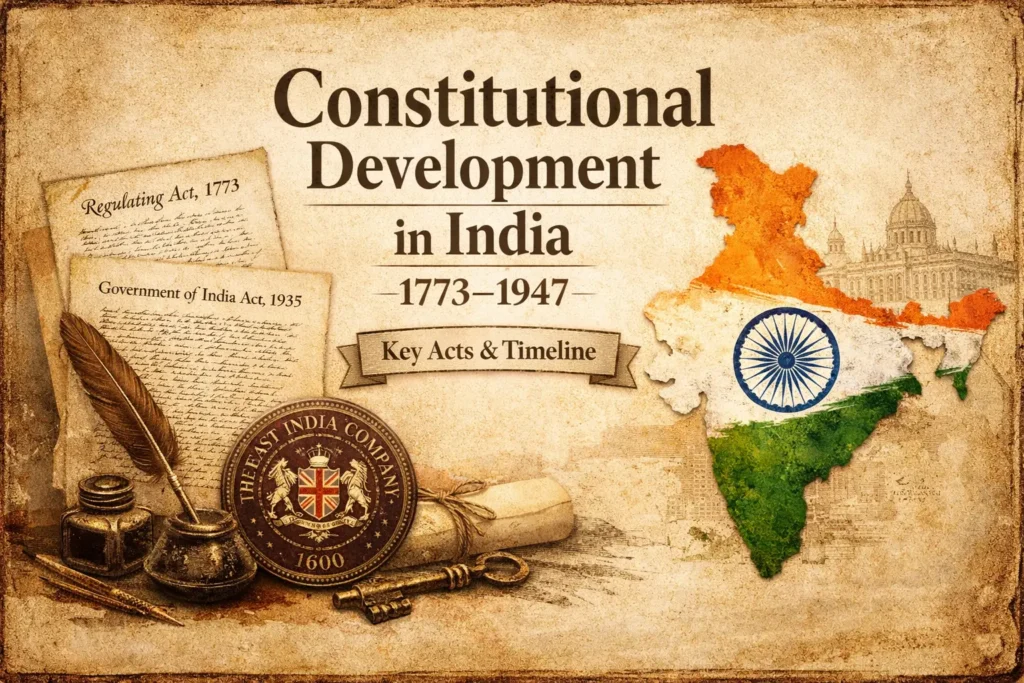
📘 Constitutional Development in India (1773–1947): Acts, Reforms, Timeline & Key Facts
Understanding the Constitutional Development in India is essential for aspirants preparing for HP Patwari, HPPSC, SSC, and other government exams. From the Regulating Act of 1773 to the Indian Independence Act of 1947, British policies gradually transformed India’s governance structure.
This article provides a complete, exam-oriented overview of all major Acts, reforms, important dates, and key personalities involved in shaping modern India’s constitutional framework.
📊 Quick Overview of Constitutional Development in India
| Act / Reform | Year | Key Feature |
|---|---|---|
| Regulating Act | 1773 | First control of British Govt over Company |
| Pitt’s India Act | 1784 | Dual system of control |
| Charter Act | 1793 | Company rule extended |
| Charter Act | 1813 | Trade monopoly ended |
| Charter Act | 1833 | GG of Bengal → GG of India |
| Charter Act | 1853 | Open competition for civil services |
| Govt of India Act | 1858 | Crown rule begins |
| Indian Councils Act | 1861 | Portfolio system |
| Indian Councils Act | 1892 | Indirect elections |
| Morley-Minto Reforms | 1909 | Separate electorates |
| Govt of India Act | 1935 | Provincial autonomy |
| Cripps Mission | 1942 | Proposal for Dominion status |
| Cabinet Mission | 1946 | Constitution-making plan |
| Independence Act | 1947 | India becomes free |
📜 Detailed Explanation of Constitutional Development in India
🔹 Regulating Act, 1773
The Regulating Act of 1773 was the first step taken by the British Parliament to control the East India Company. It made the Governor of Bengal the Governor-General of Bengal, with Warren Hastings as the first holder of this position.
👉 It also established the Supreme Court at Calcutta (1774), marking the beginning of a structured judicial system in India.
🔹 Pitt’s India Act, 1784
This Act introduced the Dual System of Control, where:
- Political affairs were controlled by the British Government.
- Commercial activities remained with the East India Company
👉 The Board of Control was created, increasing British oversight.
🔹 Charter Acts (1793, 1813, 1833, 1853)
Charter Act 1793
- Extended Company rule for 20 years
- No major structural change
Charter Act 1813
- Ended Company’s monopoly over Indian trade (except tea & China)
- Allowed Christian missionaries
- Allocated ₹1 lakh annually for education
Charter Act 1833
- Governor-General of Bengal became Governor-General of India
- Lord William Bentinck became the first GG of India
- Ended Company’s commercial activities
Charter Act 1853
- Introduced open competition for civil services (ICS)
- Separated legislative and executive functions
🔹 Government of India Act, 1858
After the Revolt of 1857, this Act:
- Ended East India Company rule
- Transferred power directly to the British Crown
- Created the post of Secretary of State for India
👉 This marked the beginning of British Crown rule in India.
🔹 Indian Councils Act, 1861
- Introduced the Portfolio System
- Allowed Indians to be nominated to legislative councils
- Decentralized administration
👉 It was the first step toward including Indians in governance.
🔹 Indian Councils Act, 1892
- Introduced indirect elections
- Allowed members to discuss the budget
👉 Though limited, it increased Indian participation in administration.
🔹 Indian Councils Act, 1909 (Morley-Minto Reforms)
- Introduced Separate Electorates for Muslims
- Increased Indian representation in councils
👉 This Act laid the foundation for communal politics in India.
🔹 Government of India Act, 1935
This was the most important constitutional reform before independence:
- Introduced Provincial Autonomy
- Proposed a Federal Structure
- Established the Federal Court
👉 Many provisions of this Act were later included in the Indian Constitution.
🔹 Cripps Mission, 1942
Led by Sir Stafford Cripps, this mission proposed:
- Dominion status after World War II
- Right of provinces to separate
👉 It was rejected by Indian leaders.
🔹 Cabinet Mission, 1946
This mission aimed to:
- Frame the Indian Constitution
- Propose a federal structure
👉 It led to the formation of the Constituent Assembly of India.
🔹 Indian Independence Act, 1947
This Act:
- Divided India into India and Pakistan
- Ended British rule
- Made India a sovereign nation
👉 It came into effect on 15 August 1947.
📅 Important Dates to Remember
- 1773 – Regulating Act
- 1784 – Pitt’s India Act
- 1813 – Trade monopoly ended
- 1833 – GG of India created
- 1858 – Crown rule begins
- 1909 – Separate electorates
- 1935 – Provincial autonomy
- 1942 – Cripps Mission
- 1946 – Cabinet Mission
- 1947 – Independence
👤 Important Personalities in Constitutional Development in India
- Warren Hastings – First Governor-General of Bengal
- Lord William Bentinck – First Governor-General of India
- Sir Stafford Cripps – Leader of Cripps Mission
- Lord Mountbatten – Last Viceroy of India
- Lord Morley & Lord Minto – Introduced 1909 reforms
🔑 Key Takeaways
- British control evolved from Company rule → Crown rule → Self-governance
- 1773–1853: Administrative control over East India Company
- 1858: Beginning of direct British rule
- 1909–1935: Political reforms & representation
- 1942–1947: Final phase of independence
👉 The Government of India Act 1935 is the most important Act for exams.
🎯 Conclusion
The Constitutional Development of India reflects a gradual transition from colonial control to democratic governance. Each Act introduced reforms that shaped India’s political system and eventually led to independence in 1947.
For exam aspirants, focusing on key features, years, and differences between Acts is crucial for scoring high marks in GK sections.
The following MCQs will help you revise these crucial events quickly and strengthen your preparation for HP Patwari and other competitive exams.
⏱️ Time Suggested: 30 Minutes
📘 Level: 10+2 Level
🎯 Useful For: HPPSC, HPRCA HP Patwari, HP Police, HP Clerk, TET
Constitutional Development in India MCQs
Q1. The Regulating Act was passed in which year?
रेगुलेटिंग एक्ट किस वर्ष पारित हुआ था?
A. 1765 B. 1773
C. 1784 D. 1793
Q2. Who was the first Governor-General of Bengal?
बंगाल का प्रथम गवर्नर-जनरल कौन था?
A. Robert Clive B. Warren Hastings
C. Cornwallis D. Wellesley
A. रॉबर्ट क्लाइव B. वॉरेन हेस्टिंग्स
C. कॉर्नवालिस . वेलेजली
Q3. Supreme Court at Calcutta was established in which year?
कलकत्ता में सुप्रीम कोर्ट की स्थापना किस वर्ष हुई?
A. 1773 B. 1774
C. 1781 D. 1793
Q4. Pitt’s India Act was passed in which year?
पिट्स इंडिया एक्ट किस वर्ष पारित हुआ था?
A. 1773 B. 1784
C. 1793 D. 1813
Q5. Pitt’s India Act introduced which system?
पिट्स इंडिया एक्ट ने कौन सी प्रणाली शुरू की?
A. Federal system
B. Dual control system
C. Judicial system
D. Provincial system
A. संघीय व्यवस्था
B. द्वैध नियंत्रण प्रणाली
C. न्यायिक व्यवस्था
D. प्रांतीय व्यवस्था
Q6. Charter Act of 1793 renewed Company rule for how many years?
चार्टर एक्ट 1793 ने कंपनी शासन को कितने वर्षों के लिए बढ़ाया?
A. 10 years B. 20 years
C. 30 years D. 40 years
A. 10 वर्ष B. 20 वर्ष
C. 30 वर्ष D. 40 वर्ष
Q7. Charter Act 1813 ended monopoly of East India Company over which trade?
चार्टर एक्ट 1813 ने कंपनी के किस व्यापार पर एकाधिकार समाप्त किया?
A. Tea trade
B. Trade with China
C. Indian trade except tea & China
D. Textile trade
A. चाय व्यापार
B. चीन व्यापार
C. भारत के साथ व्यापार (चाय व चीन को छोड़कर)
D. वस्त्र व्यापार
Q8. Charter Act 1813 allowed entry of whom into India?
चार्टर एक्ट 1813 ने भारत में किसके प्रवेश की अनुमति दी?
A. Traders B. Missionaries
C. Soldiers D. Judges
A. व्यापारी B. मिशनरी
C. सैनिक D. न्यायाधीश
Q9. Charter Act 1833 made Governor-General of Bengal as?
चार्टर एक्ट 1833 ने बंगाल के गवर्नर-जनरल को क्या बनाया?
A. Governor-General of India
B. President
C. Viceroy
D. Secretary
A. भारत का गवर्नर-जनरल
B. राष्ट्रपति
C. वायसराय
D. सचिव
Q10. Who was the first Governor-General of India?
भारत का प्रथम गवर्नर-जनरल कौन था?
A. Warren Hastings
B. Cornwallis
C. Lord William Bentinck
D. Dalhousie
A. वॉरेन हेस्टिंग्स
B. कॉर्नवालिस
C. लॉर्ड विलियम बेंटिक
D. डलहौजी
Q11. Charter Act 1853 introduced which system?
चार्टर एक्ट 1853 ने कौन सी प्रणाली शुरू की?
A. Federal system
B. Open competition for civil services
C. Separate electorates
D. Dyarchy
A. संघीय व्यवस्था
B. सिविल सेवाओं के लिए खुली प्रतियोगिता
C. पृथक निर्वाचन
D. द्वैध शासन
Q12. Government of India Act 1858 transferred power to whom?
भारत सरकार अधिनियम 1858 ने सत्ता किसे सौंपी?
A. British Parliament
B. British Crown
C. Governor-General
D. Army
A. ब्रिटिश संसद
B. ब्रिटिश क्राउन
C. गवर्नर-जनरल
D. सेना
Q13. Secretary of State for India was assisted by?
भारत सचिव की सहायता कौन करता था?
A. Cabinet B. Council of India
C. Parliament D. Governor
A. कैबिनेट B. भारत परिषद
C. संसद D. गवर्नर
Q14. Indian Councils Act 1861 introduced which system?
भारतीय परिषद अधिनियम 1861 ने कौन सी प्रणाली शुरू की?
A. Federal system
B. Portfolio system
C. Dyarchy
D. Separate electorate
A. संघीय व्यवस्था
B. पोर्टफोलियो प्रणाली
C. द्वैध शासन
D. पृथक निर्वाचन
Q15. Indian Councils Act 1861 allowed Indians to?
1861 के अधिनियम ने भारतीयों को क्या अनुमति दी?
A. Vote
B. Join army
C. Be nominated in councils
D. Become governor
A. मतदान करना
B. सेना में शामिल होना
C. परिषदों में नामांकित होना
D. गवर्नर बनना
Q16. Indian Councils Act 1892 introduced?
भारतीय परिषद अधिनियम 1892 ने क्या शुरू किया?
A. Direct election
B. Indirect election
C. Dyarchy
D. Federalism
A. प्रत्यक्ष चुनाव B. अप्रत्यक्ष चुनाव
C. द्वैध शासन D. संघीय व्यवस्था
Q17. Members under 1892 Act could?
1892 अधिनियम के तहत सदस्य क्या कर सकते थे?
A. Vote budget B. Discuss budget
C. Form government D. Amend law
A. बजट पर मतदान B. बजट पर चर्चा
C. सरकार बनाना D. कानून संशोधन
Q18. Morley-Minto Reforms were introduced in?
मॉर्ले-मिंटो सुधार किस वर्ष लागू हुए?
A. 1905 B. 1909
C. 1919 D. 1935
Q19. Separate electorates were introduced for?
पृथक निर्वाचन किसके लिए शुरू किया गया?
A. Hindus B. Muslims
C. Sikhs D. Christians
A. हिंदू B. मुस्लिम
C. सिख D. ईसाई
Q20. Government of India Act 1935 introduced?
भारत सरकार अधिनियम 1935 ने क्या शुरू किया?
A. Dyarchy at centre
B. Provincial autonomy
C. Republic
D. Cabinet system
A. केंद्र में द्वैध शासन
B. प्रांतीय स्वायत्तता
C. गणतंत्र
D. कैबिनेट प्रणाली
Q21. Federal Court was established under which Act?
संघीय न्यायालय किस अधिनियम के तहत स्थापित हुआ?
A. 1909 B. 1919
C. 1935 D. 1858
Q22. Cripps Mission came in which year?
क्रिप्स मिशन किस वर्ष आया?
A. 1940 B. 1942
C. 1945 D. 1946
Q23. Cabinet Mission came in which year?
कैबिनेट मिशन किस वर्ष आया?
A. 1942 B. 1945
C. 1946 D. 1947
Q24. Indian Independence Act was passed in?
भारतीय स्वतंत्रता अधिनियम कब पारित हुआ?
A. 1946 B. 1947
C. 1948 D. 1950
Q25. Dyarchy was introduced first in?
द्वैध शासन सबसे पहले किस अधिनियम में शुरू हुआ?
A. 1909 B. 1919
C. 1935 D. 1858
Q26. Who proposed Cripps Mission?
क्रिप्स मिशन किसने प्रस्तावित किया?
A. Churchill B. Stafford Cripps
C. Mountbatten D. Linlithgow
Q27. Cabinet Mission aimed to?
कैबिनेट मिशन का उद्देश्य क्या था?
A. Independence
B. Constitution framing
C. Partition
D. War support
A. स्वतंत्रता
B. संविधान निर्माण
C. विभाजन
D. युद्ध समर्थन
Q28. Regulating Act established which court?
रेगुलेटिंग एक्ट ने किस न्यायालय की स्थापना की?
A. Federal Court
B. Supreme Court Calcutta
C. High Court
D. Privy Council
A. संघीय न्यायालय
B. सुप्रीम कोर्ट कलकत्ता
C. उच्च न्यायालय
D. प्रिवी काउंसिल
Q29. Charter Act 1833 ended Company’s trade in?
चार्टर एक्ट 1833 ने कंपनी के किस व्यापार को समाप्त किया?
A. India trade
B. China trade
C. All commercial activities
D. Textile trade
A. भारत व्यापार
B. चीन व्यापार
C. सभी व्यापारिक गतिविधियाँ
D. वस्त्र व्यापार
Q30. Which Act made India a federal structure (proposed)?
किस अधिनियम ने भारत को संघीय ढांचे का प्रस्ताव दिया?
A. 1909 B. 1919
C. 1935 D. 1858
1-B, 2-B, 3-B, 4-B, 5-B,
6-B, 7-C, 8-B, 9-A, 10-C
11-B, 12-B, 13-B, 14-B, 15-C,
16-B, 17-B, 18-B, 19-B, 20-B
21-C, 22-B, 23-C, 24-B, 25-B,
26-B, 27-B, 28-B, 29-C, 30-C
🔗Important Links For You
👉 HP GK (Himachal Pradesh General Knowledge)
📲 Join Our WhatsApp for Daily HP GK.
📢 Get Daily HP GK, exam alerts & PDF notes directly on WhatsApp.