
HP Daily GK brings you 30 important exam-oriented GK questions for HPPSC, HP Patwari, HP Police, HP Clerk, and other HP Government exams. The HP GK questions are in both English and Hindi. The candidates preparing for HP Patwari must practice these multiple choice questions as they are based purely on HP Patwari exam syllabus.
📘 Current GK Topic: Medieval Indian History – Religious and Bhakti Movements (as per HP Patwari Syllabus)
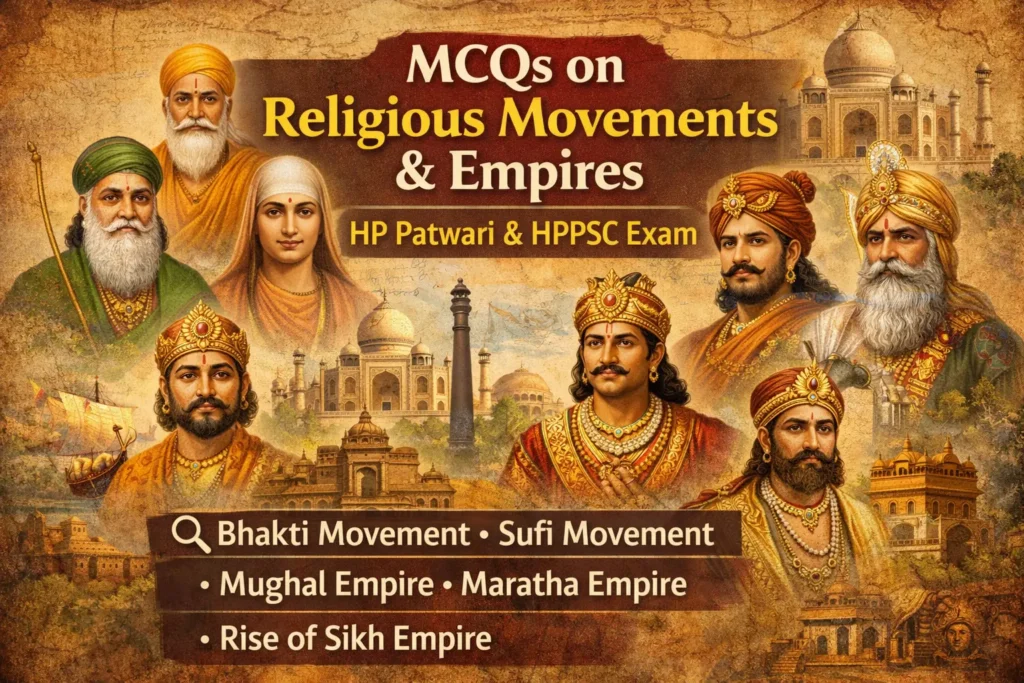
Bhakti and Sufi Movements, Mughal, Maratha and Sikh Empires – Important Notes for HP Patwari Exam
Medieval Indian history contains several important religious and political developments that shaped the social, cultural, and administrative structure of the Indian subcontinent. Topics such as the Bhakti and Sufi movements, the Mughal Empire, the Maratha Empire, and the rise of the Sikh Empire are frequently asked in competitive examinations like HP Patwari, HPRCA, HPPSC, SSC, and other state-level exams.
Understanding these developments helps candidates connect religious reform movements with political transformations that occurred between the 13th and 18th centuries in India.
Bhakti and Sufi Movements in Medieval India
The Bhakti and Sufi movements played an important role in shaping the social and religious life of medieval India. These movements emphasized devotion to God, spiritual equality, and simplicity, rather than rigid rituals and caste divisions.
The Bhakti Movement focused on personal devotion to a single deity and rejected social discrimination. Saints like Kabir, Ravidas, Tulsidas, Surdas, Mirabai, and Chaitanya Mahaprabhu spread the message of love, devotion, and social harmony.
Similarly, the Sufi Movement represented the mystical tradition of Islam that emphasized spiritual love, peace, and unity. Sufi saints of the Chishti order, such as Khwaja Moinuddin Chishti and Nizamuddin Auliya, promoted harmony among people of different religions.
Questions related to Bhakti and Sufi saints frequently appear in HP Patwari, HPRCA, and HPPSC examinations.
Guru Nanak and the Rise of Sikhism
Guru Nanak (1469–1539) was the founder of Sikhism and one of the most influential spiritual leaders in Indian history. He preached the message of “Ek Onkar” (One God) and emphasized values such as honesty, equality, hard work, and devotion to God.
Guru Nanak strongly opposed caste discrimination, superstition, and religious intolerance. His teachings later became the foundation of the Sikh religious tradition.
The Sikh religion continued to develop through the teachings of the Ten Sikh Gurus, eventually leading to the formation of the Khalsa by Guru Gobind Singh in 1699.
Questions related to Guru Nanak, Sikh Gurus, and the Khalsa Panth are common in competitive examinations.
Transition of Power in Medieval India
While religious reform movements were transforming society, India was also witnessing major political changes. Powerful empires such as the Mughal Empire, the Maratha Empire, and the Sikh Empire emerged during the later medieval period and reshaped the political landscape of the subcontinent.
Understanding these empires is important for exams because they explain the transition of power in India from the Delhi Sultanate to regional powers.
The Mughal Empire
The Mughal Empire was one of the most powerful empires in Indian history. It was founded by Babur in 1526 after defeating Ibrahim Lodhi in the First Battle of Panipat.
Major Mughal rulers included:
- Akbar – Known for administrative reforms and the policy of Sulh-i-Kul (religious tolerance)
- Jahangir – Known for patronage of art and culture
- Shah Jahan – Famous for architectural achievements such as the Taj Mahal
- Aurangzeb – Expanded the empire to its largest territorial extent
The Mughal administrative system and cultural achievements remain important topics for HPPSC and HP Patwari exams.
The Rise of the Maratha Empire
The Maratha Empire emerged as a powerful regional force during the later Mughal period and played a major role in weakening Mughal authority in India.
The empire was founded by Chhatrapati Shivaji Maharaj, who established a strong military and administrative system.
Important features of Shivaji’s administration included:
- The Ashta Pradhan Council (Council of Eight Ministers)
- A well-organized military structure
- Efficient revenue and administrative systems
The rise of the Marathas marked a major shift in the balance of political power in India.
Rise of the Sikh Empire
The Sikh Empire reached its peak under Maharaja Ranjit Singh, who established a powerful kingdom in the Punjab region in the early nineteenth century.
Key features of his rule included:
- Capital at Lahore
- Strong military organization
- Religious tolerance
- Efficient administration
The rise of the Sikh Empire represents the growing strength of regional powers after the decline of the Mughal Empire.
Quick Revision Table for HP Patwari Exam
| Topic | Important Fact |
|---|---|
| Advaita Philosophy | Founded by Shankaracharya |
| Vishishtadvaita Philosophy | Ramanujacharya |
| Dvaita Philosophy | Madhvacharya |
| Founder of Sikhism | Guru Nanak |
| Founder of Mughal Empire | Babur |
| Founder of Maratha Empire | Shivaji |
| Founder of Sikh Empire | Ranjit Singh |
Key Takeaways for HP Patwari Exam
- Shankaracharya was the founder of the Advaita philosophy (Non-dualism).
- Ramanujacharya propagated Vishishtadvaita philosophy.
- Madhvacharya established the Dvaita philosophy.
- The Bhakti Movement emphasized devotion to God and rejected caste discrimination and ritualism.
- Important Bhakti saints include Kabir, Guru Nanak, Ravidas, Tulsidas, Surdas, Mirabai, and Chaitanya Mahaprabhu.
- The Chishti Sufi Order became popular in India through Khwaja Moinuddin Chishti of Ajmer.
- Guru Nanak (1469–1539) founded Sikhism and preached the message of “Ek Onkar” (One God).
- The Mughal Empire was founded by Babur in 1526 after the First Battle of Panipat.
- The Maratha Empire was founded by Chhatrapati Shivaji, who introduced the Ashta Pradhan administrative council.
- The Sikh Empire reached its peak under Maharaja Ranjit Singh, whose capital was Lahore.
📘 Read carefully, think administratively, and link facts with concepts — this is the key to cracking HP exams.
📅 “Bhakti Movement, Mughal Empire & Sikh Empire MCQs for HP Patwari / HPPSC Exam”
Practice these 30 MCQs on Bhakti & Religious movements in India for HP Patwari, HPPSC, HP Police, and other Himachal Pradesh government exams.
⏱️ Time Suggested: 30 Minutes
📘 Level: 10+2 Level
🎯 Useful For: HPPSC, HPRCA HP Patwari, HP Police, HP Clerk, TET
Q1 Who was the founder of the Advaita philosophy in India?
भारत में अद्वैत दर्शन के संस्थापक कौन थे?
A. Ramanujacharya
B. Shankaracharya
C. Madhvacharya
D. Kabir
A. रामानुजाचार्य B. शंकराचार्य
C. माधवाचार्य D. कबीर
Q2 Ramanujacharya was the founder of which philosophy?
रामानुजाचार्य किस दर्शन के प्रवर्तक थे?
A. Advaita B. Vishishtadvaita
C. Dvaita D. Sankhya
A. अद्वैत B. विशिष्टाद्वैत
C. द्वैत D. सांख्य
Q3 Who founded the Dvaita philosophy?
द्वैत दर्शन के प्रवर्तक कौन थे?
A. Madhvacharya
B. Ramanujacharya
C. Shankaracharya
D. Chaitanya
A. माधवाचार्य B. रामानुजाचार्य
C. शंकराचार्य D. चैतन्य
Q4 The Bhakti saint Namdev belonged to which region?
भक्ति संत नामदेव किस क्षेत्र से संबंधित थे?
A. Gujarat B. Maharashtra
C. Punjab D. Bengal
A. गुजरात B. महाराष्ट्र C. पंजाब D. बंगाल
Q5 Who wrote the famous work “Gyaneshwari”?
“ज्ञानेश्वरी” नामक प्रसिद्ध ग्रंथ किसने लिखा?
A. Namdev B. Gnyaneshwar
C. Kabir D. Ravidas
A. नामदेव B. ज्ञानेश्वर
C. कबीर D. रविदास
Q6 Kabir was a disciple of which Bhakti saint?
कबीर किस भक्ति संत के शिष्य थे?
A. Ramananda B. Chaitanya
C. Namdev D. Surdas
A. रामानंद B. चैतन्य
C. नामदेव D. सूरदास
Q7 Who was the founder of Sikhism?
सिख धर्म के संस्थापक कौन थे?
A. Guru Gobind Singh
B. Guru Nanak
C. Guru Arjan Dev
D. Guru Teg Bahadur
A. गुरु गोबिंद सिंह B. गुरु नानक
C. गुरु अर्जन देव D. गुरु तेग बहादुर
Q8 Guru Nanak was born in which year?
गुरु नानक का जन्म किस वर्ष हुआ था?
A. 1469 B. 1450
C. 1475 D. 1485
A. 1469 B. 1450
C. 1475 D. 1485
Q9 Ravidas was associated with which Bhakti tradition?
रविदास किस भक्ति परंपरा से जुड़े थे?
A. Nirguna Bhakti
B. Saguna Bhakti
C. Shaivism
D. Tantrism
A. निर्गुण भक्ति B. सगुण भक्ति
C. शैव धर्म D. तंत्रवाद
Q10 Who composed the Ramcharitmanas?
रामचरितमानस की रचना किसने की?
A. Kabir B. Tulsidas
C. Surdas D. Mirabai
A. कबीर B. तुलसीदास
C. सूरदास D. मीराबाई
Q11 Surdas was a devotee of which deity?
सूरदास किस देवता के भक्त थे?
A. Shiva B. Krishna
C. Rama D. Vishnu
A. शिव B. कृष्ण
C. राम D. विष्णु
Q12 Mirabai was devoted to which god?
मीराबाई किस भगवान की भक्त थीं?
A. Rama B. Krishna
C. Shiva D. Vishnu
A. राम B. कृष्ण
C. शिव D. विष्णु
Q13 Chaitanya Mahaprabhu propagated devotion to which deity?
चैतन्य महाप्रभु किस देवता की भक्ति का प्रचार करते थे?
A. Shiva B. Krishna
C. Rama D. Durga
A. शिव B. कृष्ण
C. राम D. दुर्गा
Q14 The Chishti order was founded in India by:
भारत में चिश्ती सिलसिले का प्रसार किसने किया?
A. Khwaja Moinuddin Chishti
B. Nizamuddin Auliya
C. Baba Farid
D. Salim Chishti
A. ख्वाजा मोइनुद्दीन चिश्ती
B. निजामुद्दीन औलिया
C. बाबा फरीद
D. सलीम चिश्ती
Q15 The famous Sufi saint of Ajmer was:
अजमेर के प्रसिद्ध सूफी संत कौन थे?
A. Baba Farid
B. Moinuddin Chishti
C. Nizamuddin Auliya
D. Shah Alam
A. बाबा फरीद B. मोइनुद्दीन चिश्ती
C. निजामुद्दीन औलिया D. शाह आलम
Q16 Who founded the Mughal Empire in India?
भारत में मुगल साम्राज्य की स्थापना किसने की?
A. Akbar B. Babur
C. Humayun D. Jahangir
A. अकबर B. बाबर
C. हुमायूँ D. जहाँगीर
Q17 The first Battle of Panipat was fought in:
पहला पानीपत का युद्ध किस वर्ष हुआ था?
A. 1526 B. 1556
C. 1761 D. 1707
A. 1526 B. 1556
C. 1761 D. 1707
Q18 Akbar introduced which religious policy?
अकबर ने कौन-सी धार्मिक नीति अपनाई?
A. Din-i-Ilahi B. Sulh-i-Kul
C. Zakat D. Jizya
A. दीन-ए-इलाही B. सुलह-ए-कुल
C. ज़कात D. जज़िया
Q19 Who founded the Maratha Empire?
मराठा साम्राज्य की स्थापना किसने की?
A. Shivaji B. Bajirao I
C. Sambhaji D. Balaji Vishwanath
A. शिवाजी B. बाजीराव प्रथम
C. संभाजी D. बालाजी विश्वनाथ
Q20 Shivaji was crowned as king in which year?
शिवाजी का राज्याभिषेक किस वर्ष हुआ?
A. 1674 B. 1650
C. 1680 D. 1666
A. 1674 B. 1650
C. 1680 D. 1666
Q21 The Maratha administrative council was called:
मराठा प्रशासनिक परिषद को क्या कहा जाता था?
A. Panchayat B. Ashta Pradhan C. Sabha D. Durbar
A. पंचायत B. अष्ट प्रधान
C. सभा D. दरबार
Q22 Who established the Sikh Khalsa in 1699?
1699 में खालसा पंथ की स्थापना किसने की?
A. Guru Nanak
B. Guru Gobind Singh
C. Guru Arjan Dev
D. Guru Tegh Bahadur
A. गुरु नानक B. गुरु गोबिंद सिंह
C. गुरु अर्जन देव D. गुरु तेग बहादुर
Q23 The Sikh Empire was founded by:
सिख साम्राज्य की स्थापना किसने की?
A. Guru Gobind Singh
B. Ranjit Singh
C. Banda Singh Bahadur
D. Hari Singh Nalwa
A. गुरु गोबिंद सिंह B. रणजीत सिंह
C. बंदा सिंह बहादुर D. हरि सिंह नलवा
Q24 The capital of the Sikh Empire under Ranjit Singh was:
रणजीत सिंह के शासनकाल में सिख साम्राज्य की राजधानी क्या थी?
A. Amritsar B. Lahore
C. Delhi D. Multan
A. अमृतसर B. लाहौर
C. दिल्ली D. मुल्तान
Q25 Guru Arjan Dev compiled which holy book?
गुरु अर्जन देव ने किस पवित्र ग्रंथ का संकलन किया?
A. Guru Granth Sahib
B. Dasam Granth
C. Vedas
D. Ramayana
A. गुरु ग्रंथ साहिब B. दशम ग्रंथ
C. वेद D. रामायण
Q26 Which Mughal emperor built the Taj Mahal?
ताजमहल का निर्माण किस मुगल सम्राट ने कराया?
A. Akbar B. Shah Jahan
C. Jahangir D. Aurangzeb
A. अकबर B. शाहजहाँ
C. जहाँगीर D. औरंगजेब
Q27 Aurangzeb reimposed which tax on non-Muslims?
औरंगजेब ने गैर-मुसलमानों पर कौन-सा कर पुनः लगाया?
A. Jizya B. Zakat
C. Khiraj D. Ushr
A. जज़िया B. ज़कात
C. खिराज D. उशर
Q28 The third Battle of Panipat (1761) was fought between Marathas and:
1761 का तीसरा पानीपत युद्ध मराठों और किसके बीच हुआ?
A. British B. Ahmad Shah Abdali C. Mughals D. Sikhs
A. अंग्रेज B. अहमद शाह अब्दाली
C. मुगल D. सिख
Q29 Banda Singh Bahadur was a follower of:
बंदा सिंह बहादुर किसके अनुयायी थे?
A. Guru Nanak
B. Guru Gobind Singh
C. Guru Arjan Dev
D. Guru Ram Das
A. गुरु नानक B. गुरु गोबिंद सिंह
C. गुरु अर्जन देव D. गुरु राम दास
Q30 The Bhakti and Sufi movements mainly emphasized:
भक्ति और सूफी आंदोलनों का मुख्य उद्देश्य क्या था?
A. Religious rituals
B. Social equality and devotion
C. Political power
D. Trade expansion
A. धार्मिक अनुष्ठान
B. सामाजिक समानता और भक्ति
C. राजनीतिक शक्ति
D. व्यापार विस्तार
Answers:
1-B, 2-B, 3-A, 4-B, 5-B,
6-A, 7-B, 8-A, 9-A, 10-B,
11-B, 12-B, 13-B, 14-A, 15-B,
16-B, 17-A, 18-B, 19-A, 20-A,
21-B, 22-B, 23-B, 24-B, 25-A, 2
6-B, 27-A, 28-B, 29-B, 30-B.
🔗Important Links For You
👉 HP GK (Himachal Pradesh General Knowledge)
📲 Join Our WhatsApp for Daily HP GK.
📢 Get Daily HP GK, exam alerts & PDF notes directly on WhatsApp.