
HP Daily GK brings you 10 important exam-oriented GK questions for HPPSC, HP Patwari, HP Police, HP Clerk, and other HP Government exams. The HP GK questions are in both English and Hindi. The candidates preparing for HP Patwari must practice these multiple choice questions as they are based purely on HP Patwari exam syllabus.
📘 Current GK Topic: Indian History – Empires – Kushanas Empire (as per HP Patwari Syllabus)
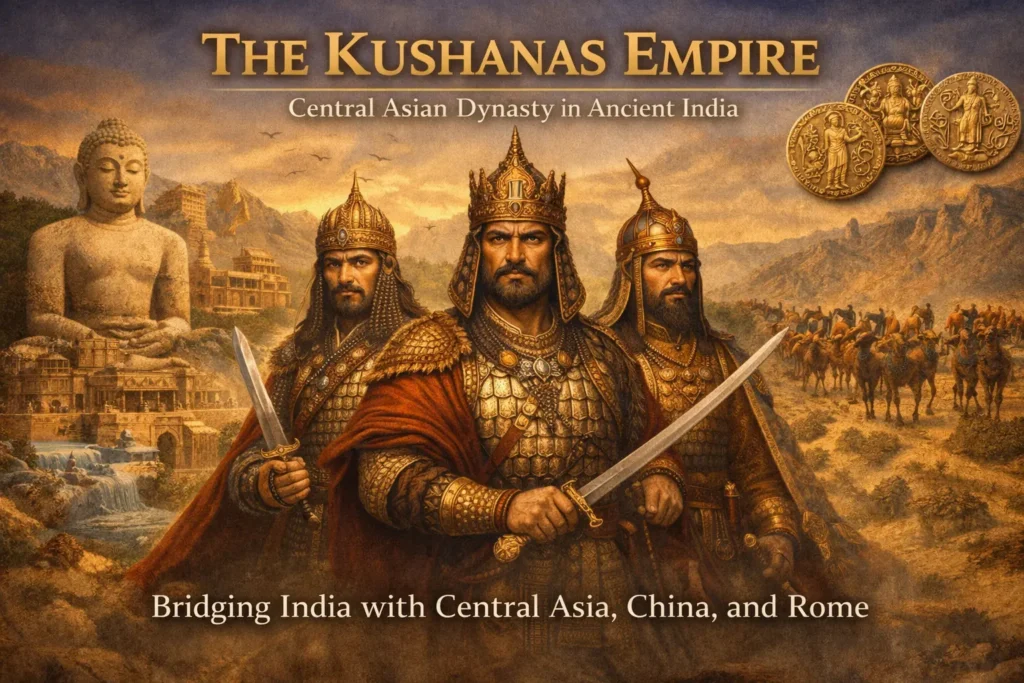
🏛️ Kushanas Empire: A Bridge Between India and the World
When we study Ancient Indian history, the Kushanas stand out as a dynasty that connected India with the wider world. Originating from the Yueh-chi tribes of Central Asia, the Kushanas established a powerful empire in north-western India between the 1st and 3rd centuries CE. Under great rulers like Kanishka, they transformed from foreign migrants into influential Indian monarchs who shaped politics, religion, trade, and art.
The Kushanas are especially important because they acted as a cultural and commercial bridge between India, Central Asia, China, and Rome. Their control over major routes of the Silk Road boosted international trade, bringing prosperity reflected in their famous gold coins. Culturally, they played a decisive role in the spread of Mahayana Buddhism, particularly through the Fourth Buddhist Council held during Kanishka’s reign. The flourishing of Gandhara and Mathura art under them marked a turning point in Indian sculpture, especially in the depiction of the Buddha in human form.
For competitive exams like HPPSC and State PSC, the Kushanas are crucial because they link political expansion, religious development, economic growth, and artistic evolution. Understanding them helps you grasp how ancient India became part of a larger Eurasian network of ideas and trade.
📘 Read carefully, think administratively, and link facts with concepts — this is the key to cracking HP exams.
🔗 Practice Daily GK here:
📅 Today’s HP GK Quiz
⏱️ Time Suggested: 10–12 Minutes
📘 Level: Easy
🎯 Useful For: HPPSC, HPRCA HP Patwari, HP Police, HP Clerk, TET
Q11. Kanishka’s empire extended up to which region?
कनिष्क का साम्राज्य किस क्षेत्र तक विस्तृत था?
A) South India
B) Central Asia
C) Bengal
D) Sri Lanka
Q12. The Fourth Buddhist Council was held at?
चौथी बौद्ध संगीति कहाँ आयोजित हुई?
A) Rajgir
B) Vaishali
C) Kundalvana (Kashmir)
D) Pataliputra
Q13. Which language was used in Kushana inscriptions?
कुषाण अभिलेखों में किस भाषा का प्रयोग हुआ?
A) Sanskrit
B) Prakrit
C) Greek
D) All of these
Q14. Which Kushana ruler issued gold coins extensively?
किस कुषाण शासक ने स्वर्ण मुद्राएँ व्यापक रूप से जारी कीं?
A) Kujula
B) Vima Kadphises
C) Huvishka
D) Vasudeva
Q15. Kushana coins show influence of which culture?
कुषाण सिक्कों पर किस संस्कृति का प्रभाव दिखता है?
A) Roman
B) Persian
C) Greek
D) All of these
Q16. The Gandhara art mainly depicts which figure?
गांधार कला मुख्यतः किसकी प्रतिमा दर्शाती है?
A) Vishnu
B) Buddha
C) Shiva
D) Mahavira
Q17. The Kushanas acted as a link between India and?
कुषाण भारत और किसके बीच सेतु का कार्य करते थे?
A) China
B) Rome
C) Central Asia
D) All of these
Q18. Which Kushana ruler adopted the title ‘Devaputra’?
किस कुषाण शासक ने ‘देवपुत्र’ की उपाधि धारण की?
A) Kujula
B) Vima
C) Kanishka
D) Vasudeva
Q19. Mathura school of art flourished under?
मथुरा कला शैली किसके अधीन फली-फूली?
A) Mauryas
B) Kushanas
C) Guptas
D) Satavahanas
Q20. Kushana administration was influenced by which system?
कुषाण प्रशासन किस प्रणाली से प्रभावित था?
A) Mauryan
B) Persian
C) Roman
D) Chinese
✅ Answers
11-B, 12-C, 13-D, 14-B, 15-D, 16-B, 17-D, 18-C, 19-B, 20-B
🔗Important Links For You
👉 HP GK (Himachal Pradesh General Knowledge)
📲 Join Our WhatsApp for Daily HP GK.
📢 Get Daily HP GK, exam alerts & PDF notes directly on WhatsApp.